
MUELAS: Bilingual Fury, Genre-Bending Riffs, and Atlanta Momentum
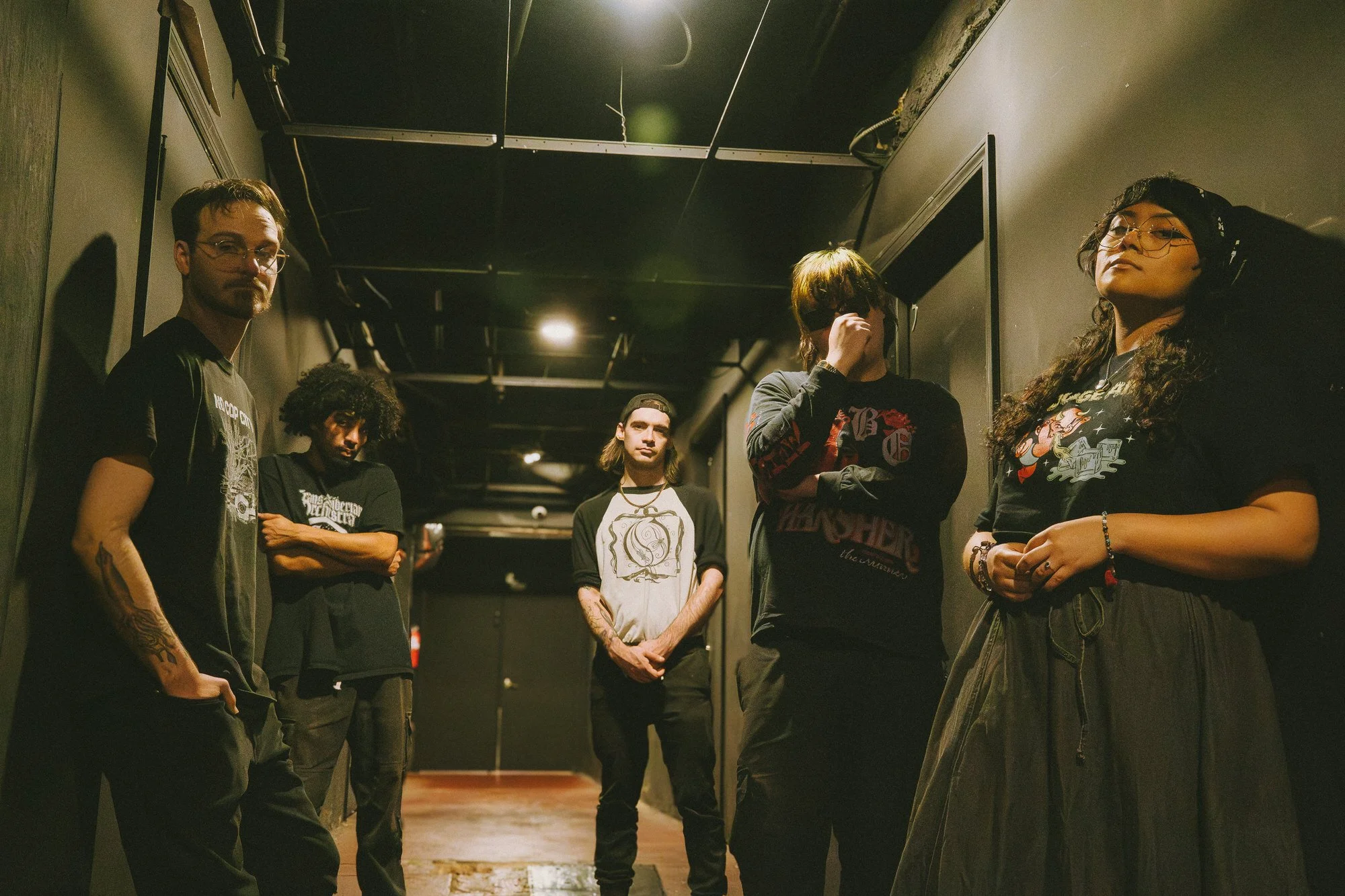
Words & Photos by Ellen Arden
Atlanta’s music scene has always embraced chaos, but MUELAS brings the kind of chaos that feels intentional — a cacophony of bilingual vocals, violin, baritone guitars, and hardcore-adjacent riffs that never stay in one place long enough to get comfortable. The five-piece (Susy Irais Reyes, Kaemon Maggard, Chris King, James Cramer, and Musashi) have only played a handful of shows, yet they’ve already earned the kind of buzz most new bands spend years chasing. And all by building a reputation for sets that are as emotionally intense as they are musically unpredictable.
Their debut, headlining at Masquerade, to a packed room on Father’s Day has caused people to take notice.
Frequency caught up with MUELAS at their practice space to talk all things noise, nuance, and the catharsis that has fueled their launch in the Atlanta scene.
Five People, One Frenetic Beginning
Long before the band existed, Susy and Kaemon were just two Atlanta show homies — running into each other at gigs, sharing music they’ve been into recently, and occasionally circling the idea of starting a band. Kaemon eventually recruited her to record violin on a Nowhere Safe track and suddenly, it snapped into focus.
“We realized we clicked very well musically.” Kaemon says.
After Nowhere Safe’s drummer moved away, Kaemon, Chris, and James found themselves at a crossroads: rebrand or start something entirely new. They chose to start something totally new and Susy was the first person they called.
“Kaemon cornered me,” Susy laughs. “He was like, ‘So… when are we starting a band?’ And I kept saying, ‘I don’t know,’ but he didn’t let it go.”
Musashi, who had played with Susy years before in a band called City Playgrounds (“Alternative jazz rock… with grandpa sprinkled in,” he jokes), soon joined. From their first session together, the chemistry was undeniable.
“If it wasn’t for Kaemon’s persistence, this band wouldn’t exist,” Susy says.
“They really made me feel comfortable enough to explore this sound I’ve wanted to do for years.”
A Sound That Refuses Lineage
Trying to describe MUELAS musically feels like trying to hold smoke. Their songs move from hardcore energy, to violin drones, to shoegaze-inspired noise walls without warning and yet it all feels incredibly cohesive.
Susy pulls from mariachi tradition and classical training, sometimes slipping into Spanish, sometimes letting out sharp, bright gritos mid-song.
“At the end of the day, I just want to scream about my feelings,” she says. “And I have a lot of feelings — personal and political.”
“MELT” channels her frustration with immigration policies (“It’s a fuck ICE song,” she says plainly). “Pesares” deals with grief — the pain of losing people, losing experiences, and losing versions of yourself, it also weaves in melodic lines borrowed from the classic mariachi song La Cigarra. Meanwhile, “Glass Smile” showcases the distinctive double beat of Cumbia rhythms.
“Politics is personal,” she adds. “And the grief in these songs are both personal and collective.”
Behind her, the instrumentation is equally unruly. Kaemon draws from jazz and metal. James’ baritone guitar sits in drop G, flattening the earth whenever he digs in. Chris’ bass tone is a roar built on a decades-old Peavey cab. Musashi slides between hardcore, hip-hop, and jazz with instinctive ease. Collectively, all these parts explode into something super charged and amorphous.
“We like too much music to stay in one mold,” Susy says.
“Hardcore-adjacent just sounded too lame to put in an Instagram bio,” Kaemon laughs.
Inside the Writing Room: “Nothing Gets Shot Down Until We Try It”
MUELAS’ writing sessions feel more like creative experiments than structured rehearsals. A song might begin with a riff from Kaemon, a textural idea from James, or a rhythmic pattern from Musashi. Together they build in layers, deconstruct, rebuild, and then question the entire thing.
“We’ll try literally anything,” Kaemon says. “Even if we think an idea sounds terrible, we’ll at least test it out. Sometimes the terrible ideas end up ripping.”
Susy, who doesn’t play guitar or bass but has dabbled in percussion, still inserts herself into the process confidently.
“I’m always like, ‘Musashi, can you try this? Can we switch that rhythm?’” she says. “The rhythm section is what gets me hooked on anything. Its the beating heart of the band.”
James, who writes in drop-G on a baritone, adds, “Sometimes what Kaemon writes in drop C is a nightmare to play on my baritone. But then I also can write something on baritone, and that’s atypical for Kaemon and Chris to write against, but we figure it out. But when it comes together its a really cool texture.”
The band jokes constantly about their writing process, but the respect inside the room is obvious.
“Everyone has their own voice,” Kaemon says. “And we lean on that instead of trying to smooth it out.”
Gear, Guts, and LED Violins
Talking gear with MUELAS is like opening a door into a loud and nerdy clubhouse.
James plays a heavily customized baritone guitar that he and Kaemon assembled themselves, mostly because no baritone on the market seemed cool enough to buy.
“So we just made it ourselves. But writing a breakdown riff in drop G is just really fucking gnarly,” he says.
Musashi often tears through cymbals and recently upgraded to Zildjian Dark crashes. His Tama kit is the same one he’s played since he was a kid, a kit he refuses to part with.
Chris plays his FGN bass through an 1982 2x15 Peavey bass cabinet powered by an Ampeg SVT-7 Pro — a thousand watt bass head.
“It’s so loud,” he grins. “It’ll destroy any bass cab I plug into.”
And then there’s Susy’s five-string Aurora LED electric violin, a glowing red centerpiece that she attacks with standard carbon bow.
“I love the sound of an acoustic violin, and when you go electric you typically get rid of what makes the acoustic violin so alive. So, we have been experimenting with that quite a bit. I also use bespoke leather rosin, but I think I might need something a little bit darker.”
Rosin might seem like a small detail, but for Susy it’s part of her entire sonic palette, its the difference between a whisper, a scream, and something in between — especially when its running through a fuzz.
Kaemon, a self proclaimed “total guitar nerd,” has been playing the same two guitars since he was a teenager, in addition to a custom build by Tom Anderson Guitars with the “hottest, gnarliest” bridge pickup made by the company. He plays his guitars through a MIG 50, a remake of the Sovtek Russian amp. He also maintains a personal library of pedals and notes one of his favorites as Death By Audio’s Octave Clang.
“I'm obsessed with that fuzz. It sounds really cool. It has a cool octave sound. It's really gross, and I'm using some pedal trickery to give it a clean blend so it doesn't overtake everything.”
The DIY Spaces That Raised Atlanta.
MUELAS talks about Atlanta with reverence, including the venues that no longer exist, such as The Bakery. A once popular but now defunct DIY space founded by Willow Goldstein in 2017 that hosted numerous art openings, workshops, and live performances.
“It was so freaking cool. It was the embodiment of what Atlanta creatives do,” Susy says. “The way they would set it up, all the galleries, and events. I miss it every day.”
Chris is quick to add His Rock, a long-gone DIY staple next to a Tyson Chicken factory, where a lot of bands got their start in the 2010s. And Musashi reminisces about Innerspace, a grassroots venue located within artist Carl Janes’ studio at Underground Atlanta. The venue offered emerging artists a space to debut their sets and find their audience.
Innerspace closed its doors for good in January 2025.
Iconic institutions like 924 Gilman Street in Berkeley, California, often credited as the springboard for the ’90s punk-revival thanks to formative shows by the early lineups of Operation Ivy, Green Day, and AFI prove just how powerful a rough-around-the-edges volunteer-run space can be. But the very qualities that make DIY spaces vital, such as; low ticket incomes, all-ages, and no-corporate-backed bookings, also make them vulnerable.
Across the U.S., numerous independent venues have struggled and/or shut down since 2020 amid rising costs, shrinking door-takes from smaller bills, the burden of lease requirements, increasing safety codes, and overhead costs that don’t shrink just because attendance is modest. The collapse of local bastions like some long-running DIY spots in Atlanta attests to how susceptible these venues have become.
When places like 924 Gilman Street vanish, the loss isn’t just a room or a stage, it’s often the first opportunity for an artist to play live, the first time a crowd gathers around something new, or a glimmer of a new scene’s foundation. DIY venues are often vital pieces of the ecosystem that grows tomorrow’s bands. But what stands out , especially in Atlanta, is the most important strata of our society — the younger generation.
“I will say it with my chest that the younger generation is keeping the Atlanta scene alive. There is a resurgence of everything, and they’re leaning into that creative freedom,” Susy says.
“There’s a renaissance happening,” Kaemon adds. “Post-COVID, people were so thankful to have shows again and they showed up hard. There are a lot of Gen-Zs coming out to shows and they’re wildly enthusiastic about the band. The community here is very cool and accepting.”
James puts it simply:
“You take for granted that in Atlanta, how accessible everything is. You can stumble into a really dope show any day of the week. You can play a show on a Monday and people will come out. That just doesn’t happen everywhere.”
From Masquerade to Sticky Sippies: MUELAS First Chapter
For a band who’s only played six shows, MUELAS have more stories about their shows than some bands have after a full year of touring.
Their debut headliner took place on June 15th to a packed house at Altar stage.
“I walked out and the room was packed,” Susy says. “On Father’s Day. On a Sunday. We were like… what the hell?”
Musashi adds, “Seeing people we didn’t even know singing along… that was wild.”
Then came the Upchuck Halloween show at the Goat Farm, a night of live painters, projections, and full-costume chaos.
Susy performed as Pearl from X, smearing makeup across her face mid-song.
Kaemon wore fishnets and heels and threw a copy of The Book of Mormon into the crowd.
Someone dressed as Doodlebob moshed past a giant hot dog.
“I had backup boots in case I bailed,” Kaemon says. “But the merch line was so long I had to wear the heels all night.”
The band has also been making an effort to connect with new fans on TikTok. Most recently making an appearance on Sticky Sippies, a platform about eclectic drinks inspired by the sound of bands from creator StickySickie. The MUELAS inspired drink was an gut-churning concoction of Espolòn tequila, mandarin flavored Jarritos, with a toothpaste, crushed Altoids and Tajin rim.
Though the band does not endorse drinking this vile mixture, their appearance on the channel prompted the question, If Muelas was a beverage, what’s in it and is anyone brave enough to drink it?
The band was quick to throw the question to resident bartender James to answer.
“So, if I were to be really serious about it, I'd probably make a really cool, mezcal negroni. Mezcal to keep Latin influence and roots because that's, like, foundationally important to us. Do some Amaro, like, Chynar to make it, a little darker. Something boozy, bitter, serious, and intense because we like to joke around a lot as individuals, but I think we take the music really seriously because we are talking about a lot of really serious shit.”
What’s Next for MUELAS
The band is careful not to overpromise, but the excitement around them is already accelerating and they are doing their best to keep up. But if the past six shows are any indication, Atlanta is more than ready to keep up with them.
A debut EP is actively in the works, along with new singles, new sounds, and an expansion of their already-beloved merch (including bandanas that nearly sold out immediately). They’re setting up an online store, planning bigger shows, and mapping out a tour for 2026.
They’re also playing The Earl on December 5, a benefit show for World Central Kitchen to feed families in Gaza, alongside Nihilist Cheerleader and BadKill.
And there are hints, subtle, but present, that national bands are paying attention.
“Some of the offers we’re getting are wild,” James says. “Next year is looking really busy.”
The band laughs about the surreal moments, like their packed show at Masquerade, Gouge Away following them on TikTok, or fans from Belfast asking for merch.
“I don’t know how to ship to Belfast,” Kaemon jokes. “That’s in Germany, right?”
Everyone nearby immediately yells “NO.”
MUELAS feels like a band in fast-forward: loud, sludgy, unpolished in the best way, deeply rooted in Atlanta, and emotionally unfiltered. They’re blending genres not because it’s trendy, but because it’s who they are — five musicians with five wildly different musical histories trying to make something new, honest, and full of explosive energy — a kind of energy that most bands have to build toward. MUELAS simply just arrived with it.
Follow @frequency.atl for local music news, interviews, and more.
Credits :
Interview: Trudie Storck
Editing: Tyler Brune
© FrequencyATL