
WIDOW 100'S : RITUAL, FIRE, AND THE LONG WAY BACK
© Ellen Arden
Words & Photos by Ellen Arden
On a Sunday afternoon, we head to Benteen Park to a small, unassuming house, tucked away quietly on an otherwise busy Atlanta street. Behind the doors, a clamor of musical equipment occupies nearly every available space — amplifiers and guitars fill the living room, stacks of pedalboards, and cables weaving, coiled, and daisy-chained across the floor. The walls offer their own introduction to the home’s inhabitants, an array of compelling Atlanta-inspired art: a screen print of Videodrome, a portrait of Martin Luther King Jr., and a print by Atlanta outsider artist Lonnie Holley.
Nothing here feels particularly staged, but everything does feel specific and curated — part rehearsal space, part living space, and part collection of the things that influence Atlanta band Widow 100’s.
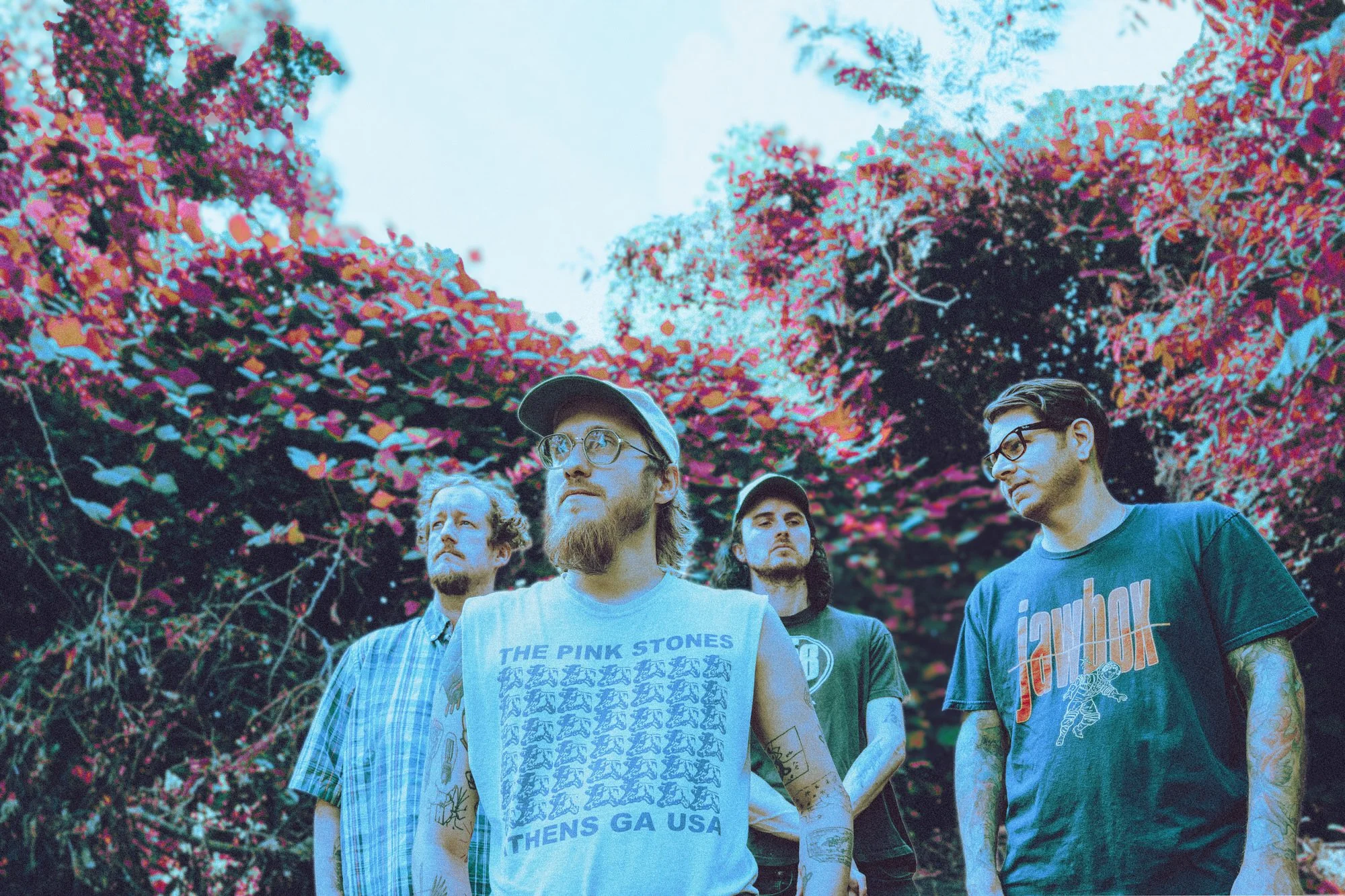
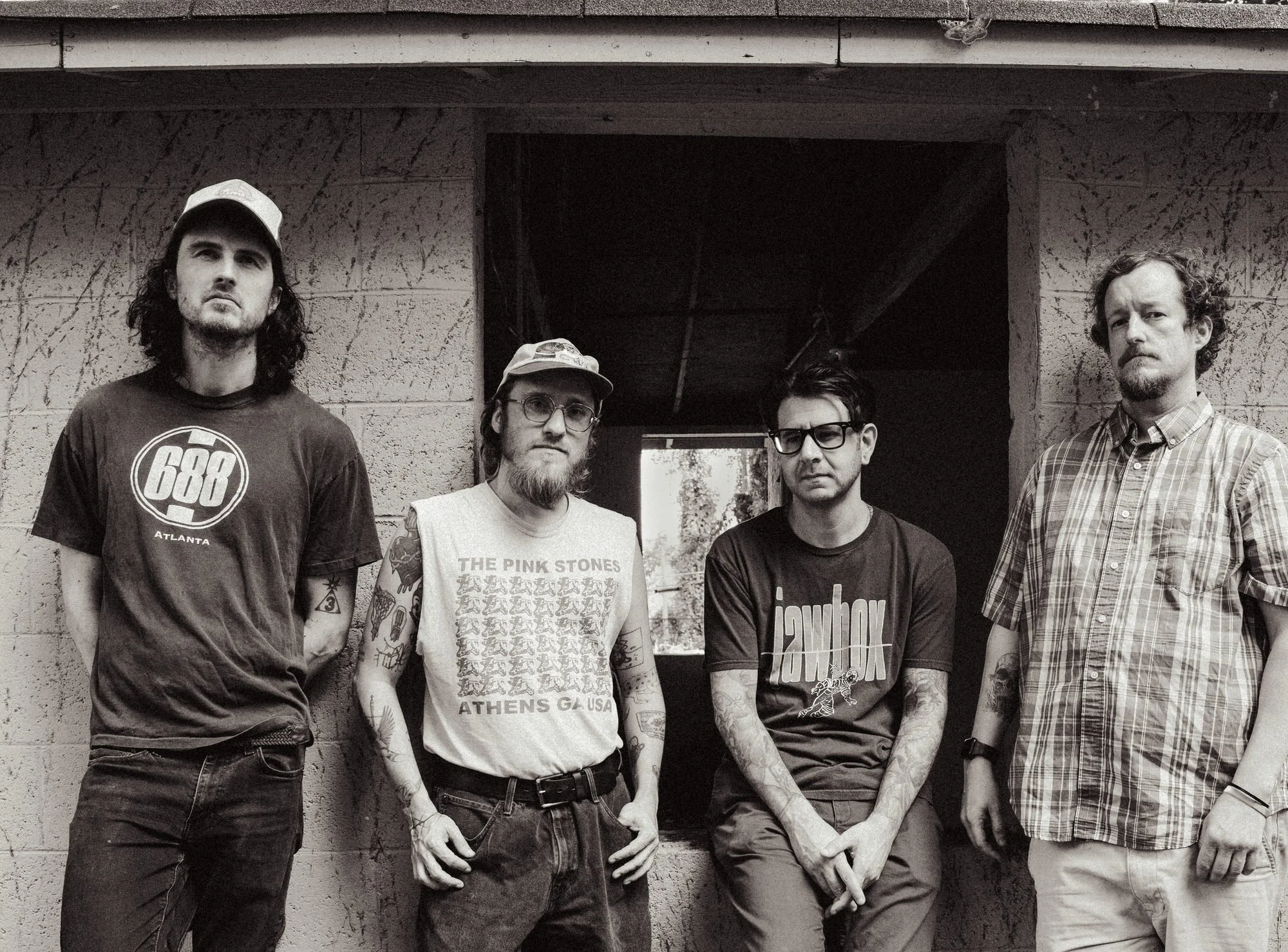
Frequency ATL met with the band — Joseph McMichen (vocals, guitar, synth), Jonathan Quinn (drums, vocals, organ), Ben Lande (guitar), and Bennett Girardot (bass, synth, keys) — on how they ended up playing together, sobriety, aging equipment, and their upcoming release Ritual Fire & Prayer.
Where It All Began
Widow100s’ origin story is, by their own admission, a winding road
Joseph and Jonathan met while working in kitchens together. "Joey had just ended things with his previous band, and he knew that I drummed, and I hadn't been playing with a band for a while," Jonathan says. “So we started mucking about with some sketches that he had. And then, as it started coming together, we started playing as a duo, and started to realize we needed to solidify the sound a little bit."
That previous band was Fox Wound, an independent alternative emo/indie rock project that was active in the Atlanta DIY scene for over a decade until eventually becoming defunct in 2023.
Before that, Joseph and Ben Lande played together in After Care, a shoegaze band that ran on and off through the 2010s, opening for Hum along the way. When Fox Wound ended, Joseph didn't waste any time jumping into something new. "I just knew that I really wanted to play music. We were supposed to play a show, and then we broke up. And I was like, okay, well, I'm gonna put another band together. So I took the five or six songs that I had, and I said, John, we're gonna play the show together in—"
"—a two-week notice, basically," Jonathan finishes. "But it worked out. And Ben and I have been living together for a long time, and always wanted to play together."
Bennett Girardot arrived almost by osmosis. He and Jonathan were also roommates, and Bennett was juggling four or five other projects at the time. "I would come home and hear them jamming, and I kind of liked their stuff more than some of the others," he says. "They got me to pick — I was like, if I have to, I'm gonna pick one of these. This is one of the bands I want to be in." That was almost exactly a year ago today.
"For the record, he's still in like four bands," Jonathan adds.
“We have a very clean, linear origin story," Ben jokes.
© Ellen Arden
Underneath the joke, though, is a band that started more as a redemption project rather than just a new creative endeavor. Joseph had relapsed on opioids after nearly a decade sober and reached out to Jonathan — who'd gotten sober before him — for help. "When I started Widow 100's, it was kind of like my way of taking an account of everything that's happened to me for the last few years, and it was almost a way to make amends to a lot of my family and friends," Joseph says. "Widow 100's, for me, is much of the chagrin of them sometimes — kind of like a diary. It's very personal. I even try to write things where I'm like, maybe I shouldn't be that personal, but I think that's just what the project is. It’s honest.”
"I think part of getting sober is becoming brutally honest with yourself and with other people," Jonathan says. "Music is a perfect way to elaborate on the emotions you're feeling while going through that — somewhat horrific but also revelatory process."
Joseph keeps coming back to one comparison for what the songwriting feels like from the inside. "I kind of feel like we're constantly writing Pinkerton by Weezer," he says. "I love that it’s a confessional thing — I love that he's embarrassed by it, and I feel that a lot too, with some of the things I write. I kind of like to dwell in that. I'm like, oh no, this is good — let's be embarrassing. I think there's something kind of cathartic about that."
The band's first release, 2025's five-song EP Cherry Burning, was recorded with Connor Ray, a longtime friend who runs Sobek Sound — the same studio all of their various bands have used over the years. Ben wasn't even fully in the band yet; he "jumped in at the very last second," with the EP otherwise recorded as a duo.
The songs started as something much quieter than what ended up on tape. "I'd written most of it on acoustic guitar, and it sounded a lot more folky when I first put it to paper," Joseph says. "I was like, oh, we're gonna record this like an almost Elliott Smith kind of EP. And then I just kept layering guitar on guitar on guitar — I have a problem where I just want to keep it going."
"It was kind of like: what happens if you make an Elliott Smith record, but try to make it shoegaze in a certain sense," Jonathan says. "Just try to layer sounds and keep the heart of the angsty, bittersweet tone underneath layers of squall."
Two songs on Cherry Burning carry a lot of weight beyond the recording session. "Sinus Rhythm," Joseph says, is the one that defines where the band was at the time — written while he was coming out of heroin withdrawal, "talking about literally feeling like there were bugs crawling in and out of my skin," and making himself a promise not to put his family through that again. "Lost Tribute" goes back even further, to a 2017 phone recording made at the house of his family's pastor, Doug Druker, right after Joseph got out of rehab at Penfield Christian Home. "It's an old worship song — I just recorded it on the phone. I thought it summed up what I was feeling ten years later when I was recording the EP," he says. It's also the track where the band's tape obsession started: "We started playing with tape manipulation, using analog equipment to give it that homey feel," Jonathan says. "The depth of tape, the warmth — which we're continuing to explore."
By the time the band got to Ritual Fire & Prayer, the analog obsession had become their whole operating philosophy. "Most of the record was done on eight-track TASCAMs, all done to cassette tape," Joseph says.
Ben traces the impulse to a shared favorite band. "We're huge fans of a band called Duster, who are kind of like the gods of bringing back tape machines and that lo-fi sound," he says. "For the new record, Joey literally had a list of songs he wanted recorded — analog on tape, digitally, and kind of hybrids. Going in, it was almost like three different albums that we melded together. Connor is so talented — somehow he mixed it so it's cohesive, while different sections of the album have these unique sonic profiles."
For Joseph, the goal isn't nostalgia so much as a deliberate embrace of the accident. "Whenever we hear bands like Duster or Have a Nice Life — bands that recorded the way they did out of necessity, because they were broke or they only had a certain amount of equipment — the records they made are some of the most brilliant, warm-sounding records," he says. "I purposely want to emulate or recapture some of that. I want our band to sound old and dirty. Connor's big joke in the studio is, he'll say, 'I hate working with these tapes, there's dirt in it, nothing ever works,' and I'm like, that's what I want it to sound like. I want things to mess up. I want reels to be unspoiled."
The next record, he says, will push even further into all-analog territory this winter.
That constraint changes how a song gets built in the room. "With digital, it's easy to just track the drums to a click, add bass, add guitar, add vocals. Whereas with tape, you're limited to your input," Jonathan says.
"You have like six tracks," Joseph says.
"Exactly. So you either have to live-track it together," Jonathan says. "But it also affects the feel of the takes — there's a Japanese philosophy about appreciating imperfections, wabi-sabi. You build in these little imperfections that add character and texture."
Joseph sums up the whole approach: "I want it to sound like a demo recorded on someone's phone in the other room. We're trying extra hard and spending all this money to make it sound bad on purpose. That's the new thing."
But none of this happens without Sobek Sound's arsenal of oddities. “Conner has a bunch of fun toys that we tend to use and abuse when we get into the studio,” Jonathan says. One of those “toys” ended up carrying the record: "Connor has this little amp that used to come packaged inside a guitar case," Joseph says. "We used that for like fifty percent of the leads. It almost sounds like it's coming out of a Fisher-Price amp. I love that. I think that's where all the magic of any of the songs happens — in the studio."
Jonathan explains the band's usual division of labor. "Joey tends to bring a song to us, in his opinion, ninety-nine percent complete, and then the rest of us will be like, well, what if we try this — sometimes there's give and take, but it does feel like sometimes we're fleshing out a skeleton," he says. "Court Order is a good example, because we were just like, well, how do we want to start this song? We'll give it a spooky, atmospheric intro and let it build from there.”
That spooky intro came from an accident during practice. "I was going back and listening to phone recordings of our practices, and the first time we played it, I was just droning the D, and Jonathan was messing around, and I was like, this sounds so cool, we have to actually do this in the song," Bennett says. "When our songs run long, it's either because we decide to add some kind of weird intro or outro segment, or we want to open up a space for them to be a little more loose, go into a more instrumental jam space. That's “Poison Swamp” in particular."
The choruses, on the other hand, are a fight Joseph regularly loses. "Sometimes they have to convince me to add choruses to songs," he says. "I'm a big fan of krautrock, and I love instrumental stuff, so a lot of times I'll get a riff stuck in my head, and I'll give it to them and say, here's a song, and they'll say, no — that's one riff." His ideal song barely has a structure at all: "I'd rather have — for me, a perfect song is one riff, and it just goes on for ten minutes, but it changes a whole bunch as it goes."
Live, the band runs louder and faster than they are recorded — "our live set's so much louder than we actually are," Joseph says, "I'd say we also play everything about 15 BPMs faster live." The gear has its own personality. "My amp is from 1969 — I think it's kind of haunted," Bennett says. "It just changes its tone depending on the humidity in the room. It's always a little different every time." Joseph's has its own decade-plus of scar tissue: "My Deville, I've had for like twelve years, and it's Frankenstein — there are different speakers in it now, and the tubes are worn out. Sometimes the definition will dive, and I'm compensating during live shows — turning up the volume, blasting things, putting my reverb all the way up. I like it to have some uncanny characteristic. I'd rather people experience something weird.”
RITUAL, FIRE, AND WHAT COMES NEXT
Joseph has described Ritual Fire & Prayer as a meditation on addiction, one built around a simple message: "It doesn't matter how terrible things get, you can bounce back and you can get your whole life back," he says. "There is a way back, if you're willing to work and put in effort, and also acknowledge that you're the one that fucked up." The title itself splits the difference between devotion and destruction — Joseph and Jonathan both carry religious trauma, and Joseph describes wanting to "marry the concepts of paganism and Christianity" without being conventionally religious at all, citing Alejandro Jodorowsky's concept of psychomagic as a touchstone. "That's what that title was about," he says. "I can get through everything I need to right now through ritual, fire, and prayer."
The record release show lands on August 20 at The Earl, with School of Design — a band Joseph predicts is "gonna be huge" — playing their first-ever live set on the same bill.
And true to form, they're not slowing down to bask in their newest release.
Joseph is already writing what he expects will become the next record, tentatively titled God's Gun Club. "Ever since I got sober, I write almost a song every single day," he says. "Most people would send one demo," Jonathan adds. "Joey sends six at a time." Joseph doesn't apologize for the pace: "I truly believe in my heart there is something to putting artificial deadlines on people. I've been in so many projects in the past where you just feel stagnant, you're bored, you waste time. Now I'm so motivated, I actually want to do things. I feel like I’ll never let us stop moving, for better or worse.”
Listen to Ritual Fire & Prayer, streaming everywhere now. And catch Widow 100's at their record release show this Thursday, August 20th, at The Earl with support from School of Design, Big Yellow, and Voice of Chuck.
Follow Frequency.ATL for local music news, interviews, and more.
CREDITS :
Interview: Ellen Arden
Editing: Tyler Brune
© FrequencyATL