
Welcome to K3YP4RTY : Bringing kink, camp, and horror out of the dungeon and into Atlanta’s live music scene.
© Ellen Arden
Words by Erin Chaney
Photos by Ellen Arden
What happens when you write with your partner about your fetish alter egos, add camp and horror, and set it all to a driving beat? Apparently, you get K3YP4RTY.
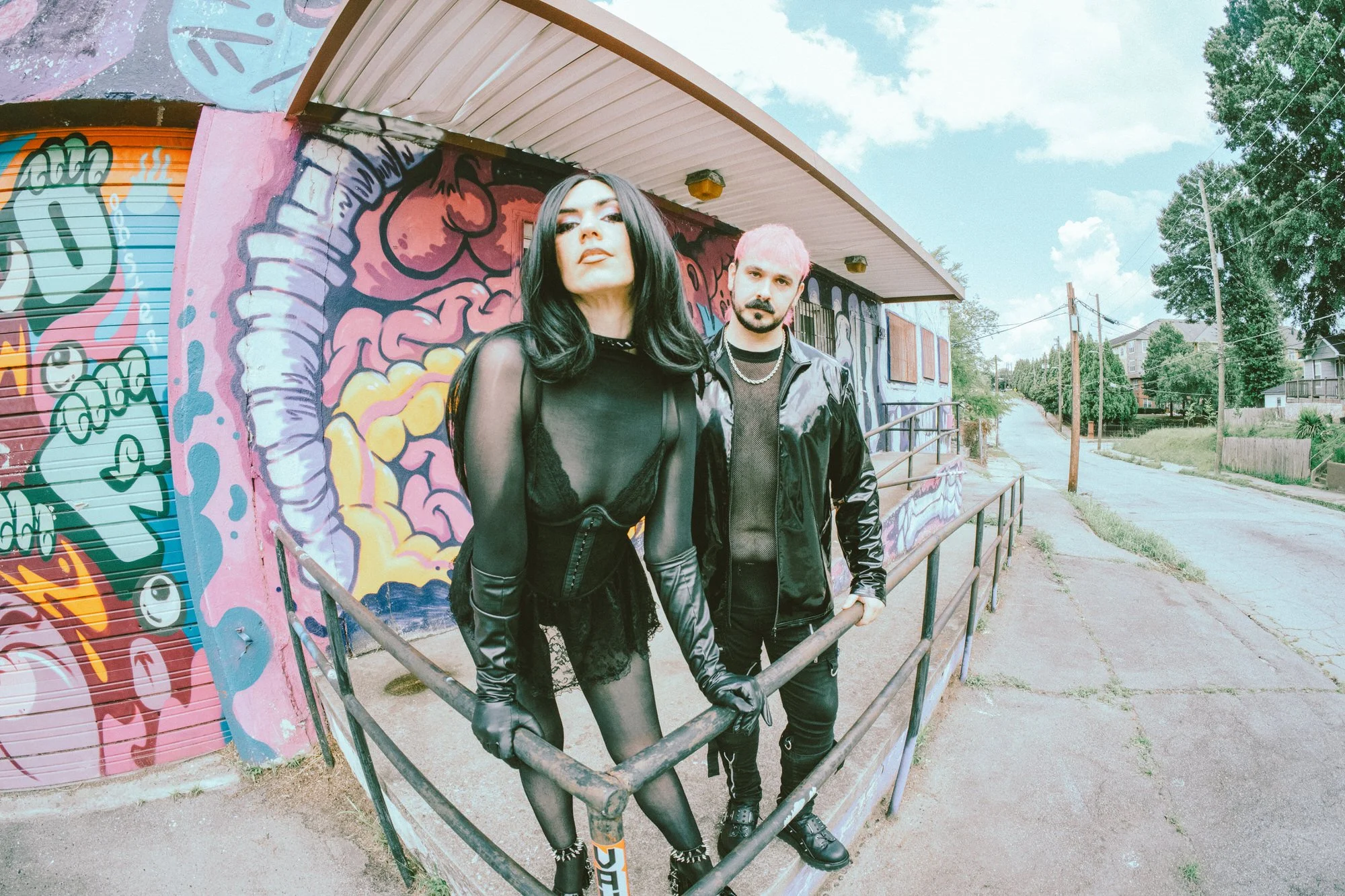
During Frequency’s photo shoot with K3YP4RTY (married couple Acadia and Asher Grey), we found a disintegrating parking lot with some murals as a backdrop. The cracked concrete wasn’t ideal for Acadia’s studded platform heels, so Asher dutifully took her hand and helped her across the street. True to ATL form, a man driving by clocked her in her stunning dress, yelling out “GOT DEYAM!”
Acadia barely registered it. This was, quite literally, a Monday.
Asher grinned slyly toward the driver, then to us as he opened the car door for Acadia. “I know, man. That’s my wife. How do you think I feel?!”
If you’re reading this and aren’t picturing a modern-day Morticia and Gomez Addams moment, you’re simply not a romantic. Asher and Acadia met while touring in the music scene and have been together ever since, playing and songwriting in various projects. As professional dominants, it now seems inevitable that they would write what they know; the kinks and fetishes explored by their varied clientele. While of course many sex workers are artists (some less publicly than others), it was a conscious decision by the Greys to bind their work with their musical play in K3YP4RTY. It was one they did not take lightly.
Frequency spoke to K3YP4RTY’s Acadia Grey and Asher Grey just before their latest music video release for “Mantra,” and the start of their Latexxx Tour to discuss their band, their music, and life in Atlanta’s alternative music scene.
Becoming K3YP4RTY
Before K3YP4RTY, Acadia and Asher had written across genres for other artists, companies, and creative projects but none of it felt entirely their own. Then the concept for K3YP4RTY emerged during a long road trip, when the pair began discussing their work in the BDSM space and what had been missing from their previous work in music.
“We kept looking for inspiration, and it didn’t exist,” Asher says. “We started writing down song topics and project names. It was probably a ten-hour road trip, and by the end, we had a list of ten songs and the name of the project.”
The first song they completed was “Worship My Body,” which established the foundation for the sound and world they would continue building. Their sound may pull from several corners of alternative music, but the project’s purpose became clearer as the Greys considered how kink and sex work were represented in popular culture.
“We created an alternative electronic sound that embodied our history in alternative music,” Asher explains. “There were influences from bands that would have played Warped Tour, but also our experience working in nightclubs and enjoying EDM. We wanted to turn all of that into a performance.”
© Ellen Arden
“There are a lot of artists who use BDSM and sex-work imagery or language, but they never recognize sex workers,” Acadia says. “They use our imagery, our history, and all these other things to amplify their message without that recognition. A big piece for us was realizing we had to do this because no one else was.”
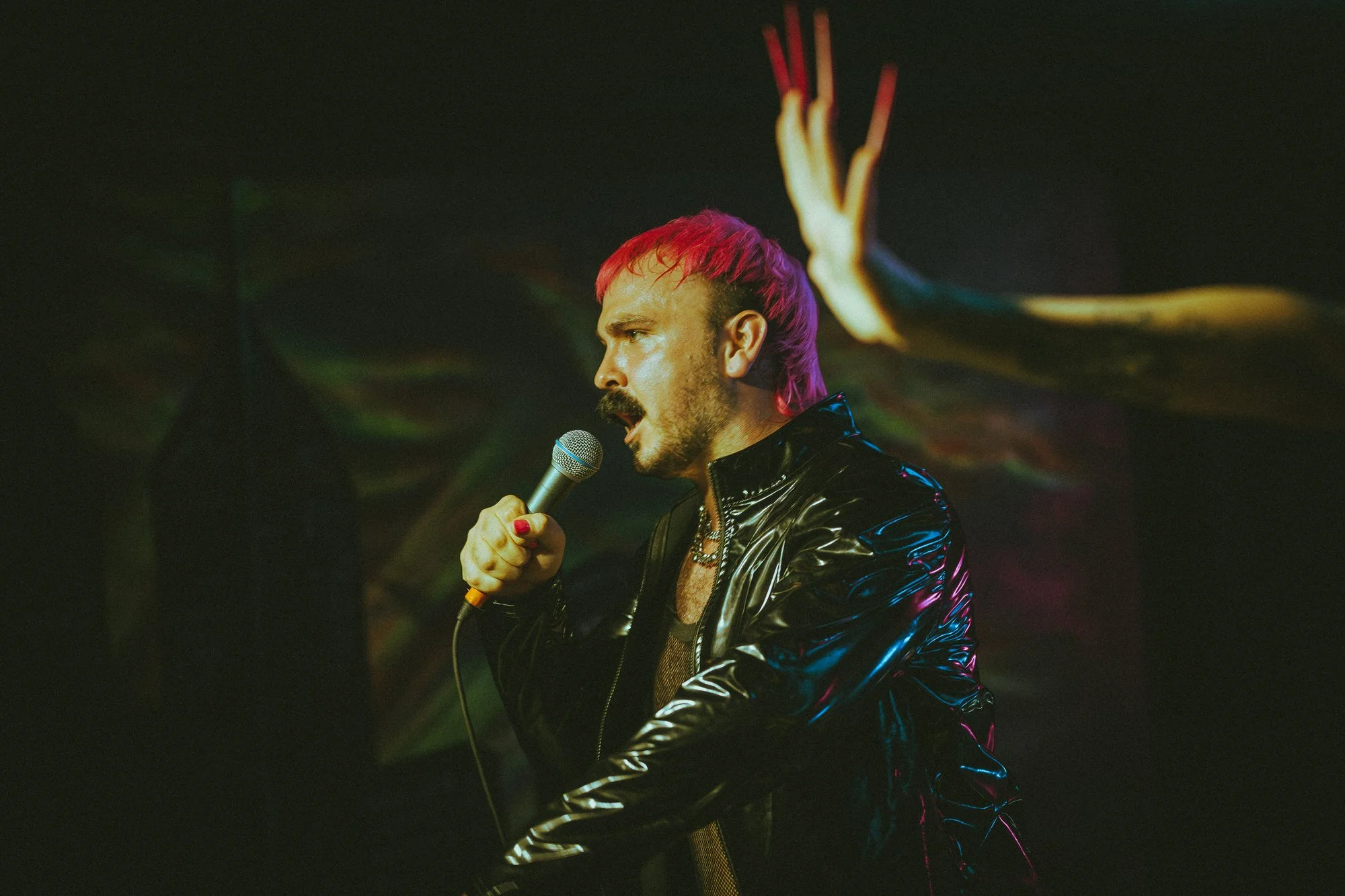
“Something I've noticed in the last year is that we get on stage and we talk about what we do, and we realize that a lot of people [bands] have a stance, and they'll get on stage, and say ‘we don't agree with the government, and we don't agree with X, Y, and Z and it starts to feel like it's rehearsed. But we get onstage and talk about what we do,” Asher adds. “We are championing sex work, and that pretty much tells you everything you need to know about us.”
“It’s a shorthand way of saying we wouldn’t be representing this if we stood for those other things,” Asher continues. “It feels good to be one of the few projects openly championing sex work and body rights.”
Camp, Horror, and Control
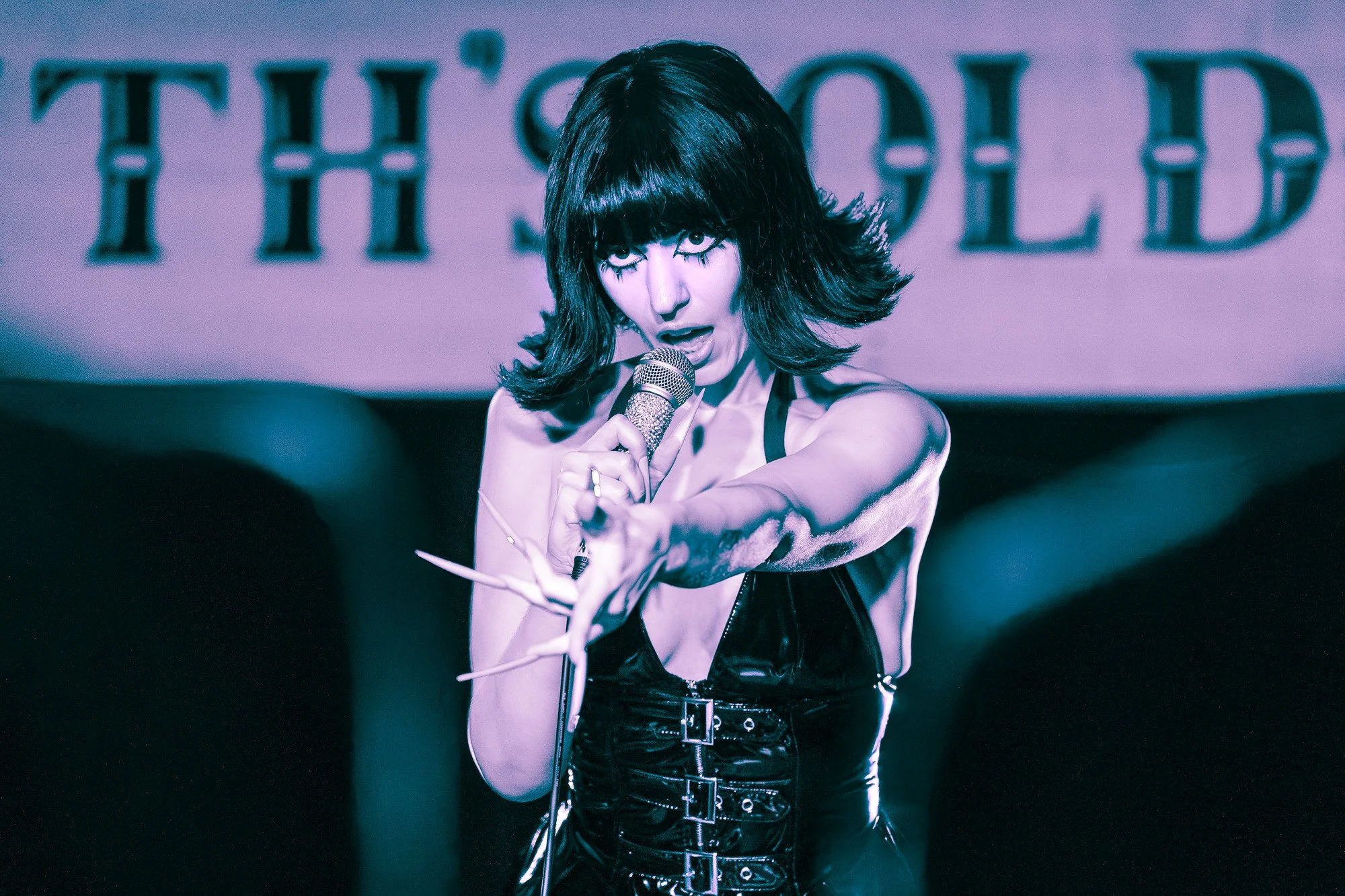
K3YP4RTY was never designed to function as a conventional band. Acadia’s background in musical theater helped shape the project into something closer to a performance world—one with its own characters, rules, visual language, and often a sense of humor.
“The two biggest themes are horny and horror,” Acadia says. “Base level, everything we do is scary and sexy.”
Fear and arousal often exist near one another, particularly within BDSM, where tension, anticipation, trust, and control can become part of the overall experience. Those dynamics also reflect the way society responds to desires it does not understand. The resulting world is theatrical, but it is not relentlessly serious. K3YP4RTY leaves room for absurdity.
“People get scared of things they don’t understand,” Acadia says.
“That fear can become entangled with shame," Asher adds. “Particularly when people are taught that certain desires are wrong. Those things can become exciting because they’ve been framed as forbidden. That fear, and the story of the power dynamic, helped create this idea of a retro horror performance piece,” he says.
“Some people approach it like everything has to be, ‘I’m so sexy,’” she says. “K3YP4RTY is a little silly. Things happen during scenes or sex where you have to laugh, and that gets lost because everybody is so worried about being hot. But K3YP4RTY is camp. We don’t take ourselves too seriously. But we do take how we represent fetish culture and the kink community very seriously.”
© Ellen Arden
Beyond The Latex
Behind the latex, horror imagery, and theatricality is a highly methodical songwriting process that revolves around an ever-growing list of kinks and fetishes. Musically, K3YP4RTY draws from dance music, electropunk, club culture, alternative rock, and the international rave scenes.
The punk-electronic collision of The Prodigy became an early reference point for K3YP4RTY, while Nina Hagen’s showmanship showed Acadia what it could look like to commit completely to a character, while Peaches offers something even more foundational: proof that sexually explicit music can be political, empowering, and deeply intentional.
“Peaches laid the foundation that gave K3YP4RTY ground to build on,” Asher says.
For Acadia, Hagen’s commitment to performance was equally influential on K3YP4RTY. Having begun her own musical career in opera at around eleven years old, she found a point of connection in Hagen’s operatic background and the visual language she brought into punk.
“Seeing the theatricality, the choices, the craziness, and even the way she handles interviews is so inspiring,” Acadia says. “She is always 110 percent dialed in.”
When approaching writing, Asher notes that they often start by listening across genres, paying attention less to specific sounds than to the moments that instinctively make him want to get up and move. From there, he looks for a tempo, key, or energy K3YP4RTY hasn’t explored yet.
Once an instrumental structure is in place, the pair return to the lyrical ideas they have collected around the song’s central fetish or kink. A track can sometimes be written and recorded within a day or two. Finding its voice, however, can take longer.
“Almost every song sounds different,” Acadia says. “We use different voices, so we have to find the character and the pocket for each song. Like for “Take It Like a Man,” we wanted it to have that whiny, Bikini Kill riot-grrrl punk energy Acadia says. “Once we found that, it set the precedent.”
Their newest release, “Mantra,” puts that process into practice, drawing from the Greys’ experiences with submissives interested in hypnosis and mind control and combining it with vampire mythology. Asher describes the result as a “vampire dungeon anthem,” one K3YP4RTY uses to open its live sets and immediately pull the audience into their world. “Our idea was, you’re under our spell now,” he says. The accompanying video takes the concept into medical horror, with Acadia playing a latex-clad nurse who experiments on Asher’s brain, ultimately transforming him into what she calls her “latex minion.”
The Key to K3YP4RTY
When the Greys began searching for a producer who could help realize the full scale of K3YP4RTY, not everyone was comfortable with the project.
Years earlier, during their period of commercial songwriting, Asher had attended the University of Georgia with Robert Brooks who later moved to Austin and founded the electronic music festivalILLfest. Through that connection, the duo encountered producerXYAN. When K3YP4RTY began taking shape, XYAN was at the top of their list to produce.
“We reached out to five or six different producers,” Asher says. “He was the only one who said, ‘I think it could be something really cool.’”
Others did not respond or made it clear that the project was not for them. Some were uncomfortable with fetish culture; others did not view the concept as serious enough. XYAN helped the duo complete their first single “Worship My Body” and has remained their primary mixing and mastering engineer, turning the material they create at home into the larger, bass-heavy club sound they envisioned.
“K3YP4RTY would not be K3YP4RTY without XYAN,” Asher says.
Finding the Right Audience
The provocative surface of K3YP4RTY can make it easy for some listeners and industry professionals to stop at the initial shock. With some people ignoring their emails or directly telling them that their music was not for them, the Greys know the project will close some doors. At the same time, others have responded with relief at hearing fetish and sex work discussed openly, accurately, and without condescension.
“For every person who says, ‘This is not for me,’ somebody else says, ‘You’re talking about things I’ve never heard people talk about, and you’re doing it respectfully. I want to give you an opportunity,’” Asher says.
That support has led K3YP4RTY into spaces where their work is understood as more than a novelty. Rather than trying to appeal to everyone, the Greys have leaned further into the communities already receptive to the work: fetish events, goth nights, darkwave spaces, and the parts of Atlanta’s alternative scene where theatrics and subculture are treated as serious forms of expression.
Atlanta’s goth community has been particularly welcoming.
“So much of goth as a subculture comes from kink and fetish,” Acadia says. “That gets lost, especially now with the fetishization of goth girls on TikTok and social media.”
Because K3YP4RTY approaches those influences from within the culture rather than borrowing them from the outside, Acadia understands why some people may initially approach the duo with caution. The reception they have received has made that acceptance even more meaningful. K3YP4RTY was never meant to be universally palatable. Its world is too specific, too theatrical, and too invested in the people who built the culture it represents.
“We always say K3YP4RTY is not for everyone,” Acadia says. “It was never supposed to be. If it made you feel something—even if that feeling was disgust or hate—then we made you feel something. And that’s art.”
What’s Next for K3YP4RTY?
For K3YP4RTY, what comes next is already taking shape.
The duo is heading out with Kyd Barrett and Nixon In China on the Latexxx Tour, presented by Atlanta’s Club de Vampiros. The east coast tour kicks off this Saturday, July 25th, in Atlanta at Lore, and features dates in Athens, Asheville, Richmond, and New York City.
K3YP4RTY is also expanding the world of their latest single, “Mantra,” which already opens their live sets, pulling audiences into its hypnosis and mind-control-inspired refrain from the moment the show begins. That world now moves onscreen with the release of the song’s new music video, directed by Jakey Lutsko, premiering today.
Watch the exclusive premiere of K3YP4RTY’s “Mantra” here on FrequencyATL.com
Follow Frequency.ATL for local music news, interviews, and more.
CREDITS :
Interview: Ellen Arden & Erin Chaney
Editing: Tyler Brune
© FrequencyATL