
Finding Comfort in Chaos : Inside the world of Squeamish
© Ellen Arden
Words and Photos by Ellen Arden
From the sidewalk outside Pizza Verdura Sincera, the show looks almost unreal.
Inside, a packed room full of bodies moving under fluorescent lights while curious pedestrians stop to peer through the windows along Moreland Avenue. Merch tables spill out onto the sidewalk because there isn't enough room inside. Even the crowd extends beyond the walls of the restaurant, forming clusters around the building. This is the kind of scene that feels uniquely Atlanta — a hardcore show inside a vegan pizza shop. Musicians, artists, photographers, and regulars all occupy the same stretch of pavement. Through the glass, the bands look as though they are suspended inside of their own tiny aquarium.
Somewhere between the fishbowl atmosphere inside the venue and the dumpsters out back, our conversation with Squeamish begins to take shape.
The band spends much of our time together talking about Atlanta—but rarely in straightforward terms. They describe the city as both beautiful and dystopian, a place where rap and punk belong to the same creative ecosystem and politically charged music doesn't necessarily make for a political band. Even Squeamish's own history reflects that way of thinking, beginning with two separate projects that eventually collided and evolved into something new.
Contradiction, as it turns out, might be one of Squeamish’s most defining qualities.
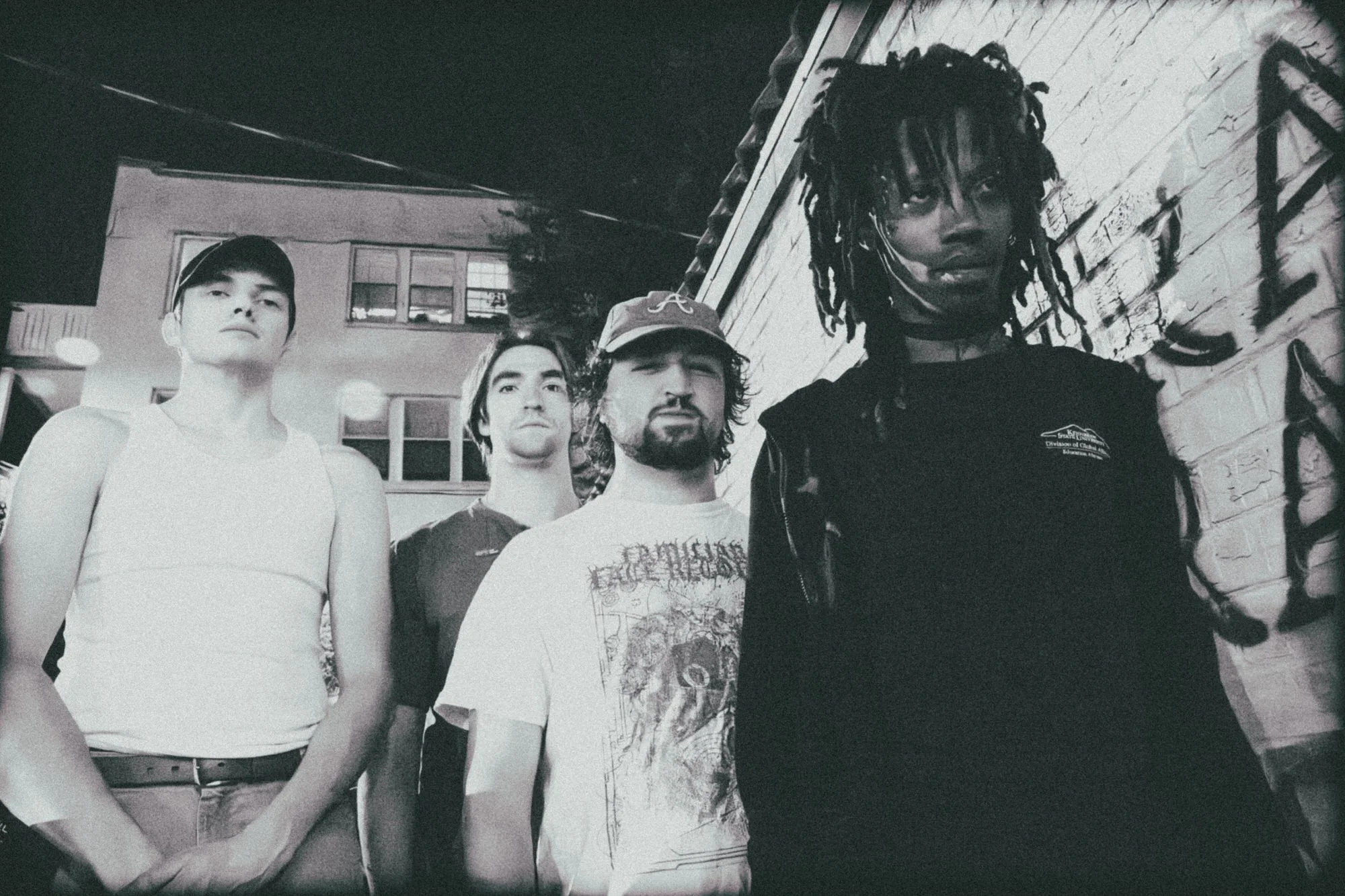
The band's earliest incarnation dates back to 2019 when vocalist Father Abstrakt and his brother Cerb, and guitarist Thankyousomuch, began experimenting with what he describes as “a digital industrial project." At the time, it was less a full band than an ongoing creative experiment. The current version emerged years later when that project unexpectedly collided with members of a post-punk band that included guitarist Conor Ray, drummer Hayden Stadler, and bassist Simon Cohen. Tonight, Thankyousomuch is absent from the conversation, but his presence is felt constantly as stories bounce between members as the band's history gets reconstructed in real time.
Ray still recalls the first time he saw Father Abstrakt and Thankyousomuch perform —
“I remember him and AJ (Thankyousomuch) showed up and played in front of drum tracks,” Ray says. “Literally that night I was like, yeah, fuck our band. Let’s blow this band up.” The story gets a laugh, but it also says something about how Squeamish came into focus. The band wasn’t built from one singular idea so much as a collision of separate projects, different musical instincts, and a shared willingness to let the mess become part of the overall shape. That same energy carries into the way they describe their sound: “confrontational and erratic,” not for shock value, but because discomfort is part of the point.
For Abstrakt, confrontation has less to do with aggression than discomfort — making the audience, and sometimes himself, sit inside something uneasy. “I’m really big on making people and myself feel uncomfortable sometimes,” he says.
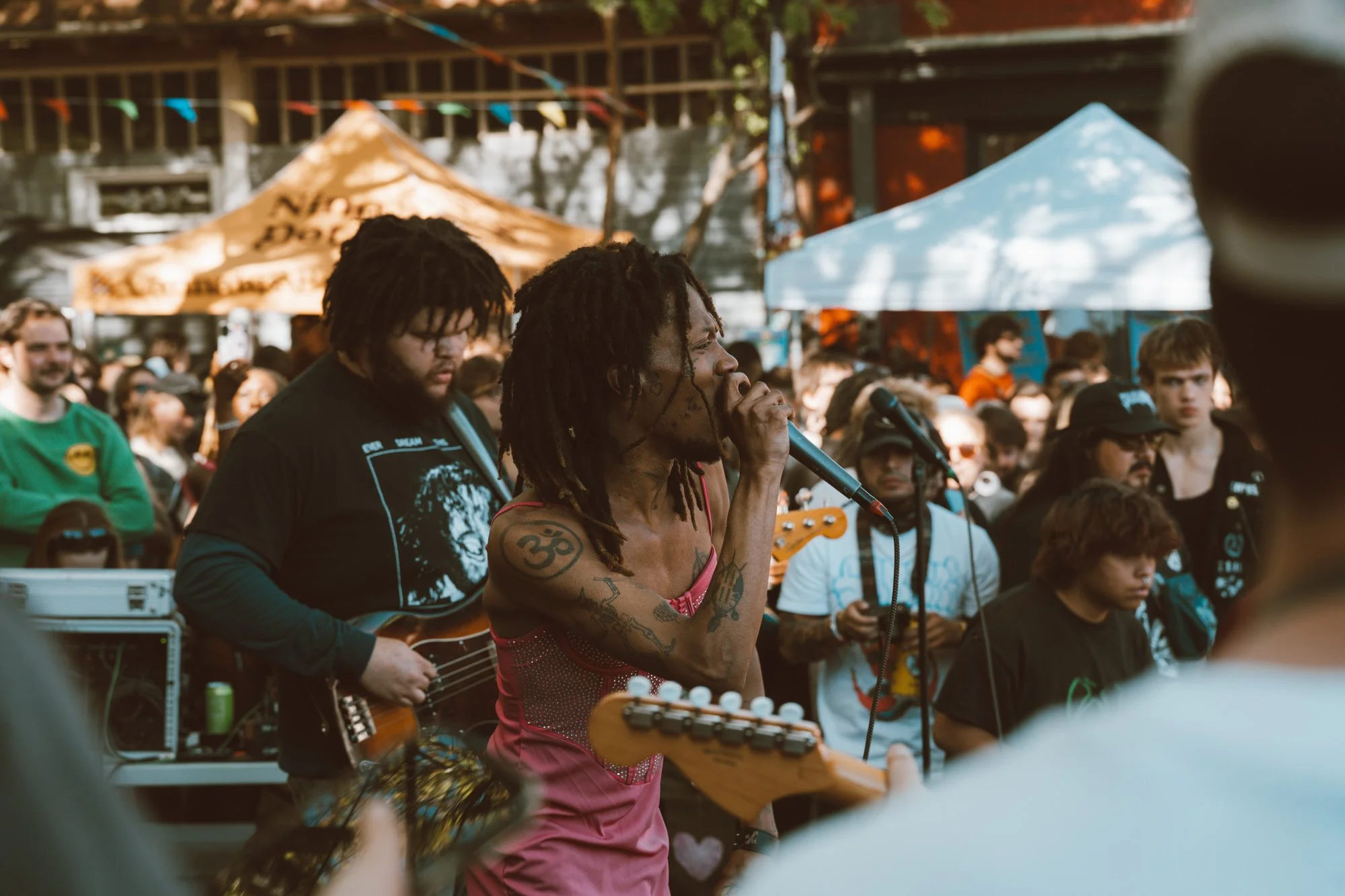
That discomfort doesn’t just stay contained in the lyrics. It shows up physically at shows, when audiences sometimes have to figure out how to move to Squeamish in real time. Songs shift into odd rhythms, instruments overlap, and the performance can feel like it’s pulling in several directions at once without ever coming apart. “Sometimes the audience doesn’t really know what to do,” Stadler says. “Some bands might see that as a bad thing, but to us that’s kind of part of the experience.”
That willingness to let uncertainty stay visible also shapes how the band writes. Ideas arrive in pieces — a lyric Abstrakt drops into the group chat, a riff someone brings in, or something found through jamming until it starts to take form. Nothing feels overly controlled. The songs are built collectively, like the band itself: collision first, structure after.
"We'll find something that's good and be like, we need to build on that," Stadler explains, while Ray describes much of the process as operating in “a kind of flow state.”
© Ellen Arden
That intuitive flow state process may also explain why Squeamish feels difficult to categorize. Throughout the interview, references to Black Flag, Bad Brains, Reagan Youth, and The Stooges sit comfortably alongside discussions of Young Thug, underground Atlanta rap, noise music, jazz fusion, and local experimental artists. The band may describe itself simply as “a punk band from Atlanta,” but the closer you listen, the less useful that label becomes. Squeamish exists inside Atlanta’s punk and hardcore scene, but they don’t seem particularly interested in treating genre like a boundary.
Atlanta appears repeatedly throughout the interview, not simply as a hometown but as a source of inspiration, and of course, contradiction. Abstrakt enthusiastically cites local noise artist Frank/ie Consent and Atlanta rapper Leeks among his biggest influences. Ray mentions Upchuck, Improvement Movement, Officer Down, and a long list of local bands that helped shape his understanding of the city's creative landscape. Rather than describing separate scenes, the band talks about a larger community where influences constantly overlap and multiple scenes merge into one.
© Ellen Arden
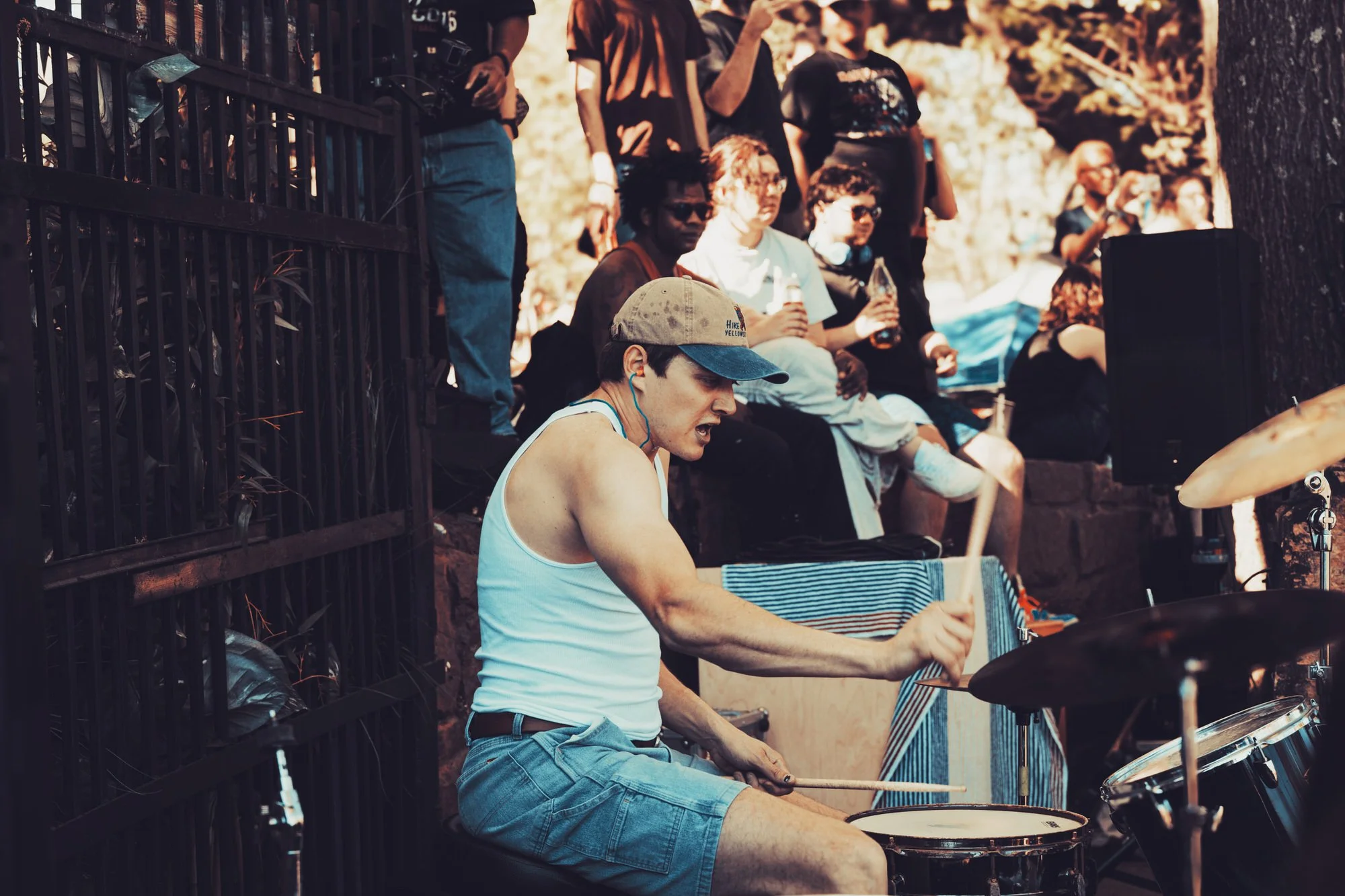
Their perspective reflects a city that has rarely fit neatly into a single musical identity. While Atlanta is recognized around the world as one of hip-hop's creative capitals, its underground has long thrived on overlap. Punk bands share bills with rappers. Noise artists collaborate with experimental musicians. DIY spaces become gathering places for communities that don't always fit inside traditional venues. "I feel like a lot of people now would say there's not really two separate scenes," Stadler says. In many ways, Squeamish sounds like the product of that environment and their music reflects the same fluidity witnessed around them. Rap and punk are not opposing forces. Neither are politics and entertainment. Neither are beauty and dysfunction. The city itself seems to operate according to a similar set of rules.
With singles like “Built on Blood” and “Burn Down Stone Mountain” — nowhere is that perspective clearer than on “Atlanta Is Babylon.” When asked about the title, Abstrakt speaks about the city with obvious admiration before complicating the thought almost immediately.
"Atlanta is a beautiful city," he says. "I honestly think this is one of the greatest cities on Earth."
Then he pauses.
"But it has a weird dichotomy.”
The word hangs over the rest of the conversation. Dichotomy. It's difficult not to hear it echoed throughout everything the band has already described about themselves and Atlanta — a city whose greatest strengths often seem inseparable from its biggest frustrations.
"Atlanta is like a microcosm. It's got some of the highest highs and the lowest lows of America,” says Ray.
Atlanta is a city where cultural brilliance and civic unease often occupy the same block. It creates thriving underground art communities while becoming increasingly difficult for many of those same artists to afford living here. Some of the country's most exciting creative energy exists alongside many of the same inequalities and anxieties found throughout America. But Atlanta has also long built its identity on reinvention.
Listening to the band describe the city, it becomes increasingly difficult to separate Atlanta from Squeamish itself. The same contradictions they admire and wrestle with in their hometown surface throughout their music. Rap and punk aren't opposing forces. Neither are politics and entertainment. Neither are beauty and dysfunction. In Atlanta, those boundaries rarely survive for long.
That perspective also explains why nobody in Squeamish seems eager to describe the band as overtly political. Their songs respond to the world around them, but they stop short of treating music like a manifesto. “I don't think Squeamish is trying to make political waves," Ray says. "But when you're writing songs and lyrics, you write them about stuff that means something to you.”
For Stadler, that returns to the same idea that surfaced earlier in the conversation: discomfort.
"A lot of things that are happening politically right now are uncomfortable to talk about," he says. "Music is a great avenue to express those feelings and ideas while also being confrontational.”

© Ellen Arden
What’s Next Squeamish
For now, Squeamish remains focused on writing. Rather than treating each release as a definitive statement, the band sees its catalog as an ongoing record of where they are creatively and personally. "I feel like all of our releases reflect the time they were released in," Abstrakt says. "I like making music that's timeless, but also sounds like whatever's going on right now." It's an approach that suggests the next chapter won't arrive by abandoning what came before, but by continuing to document the city, the people, and the contradictions that continue shaping our existence.
Catch Squeamish Friday, July 17th at The Goat Farm or at The Milestone Club in Charlotte, NC on July 23rd.
Follow Frequency.ATL for local music news, interviews, and more.
CREDITS :
Interview: Ellen Arden
Editing: Tyler Brune
© FrequencyATL