
Yard Work : The Sound of Leafblower
© Ellen Arden
Words and Photos by Ellen Arden
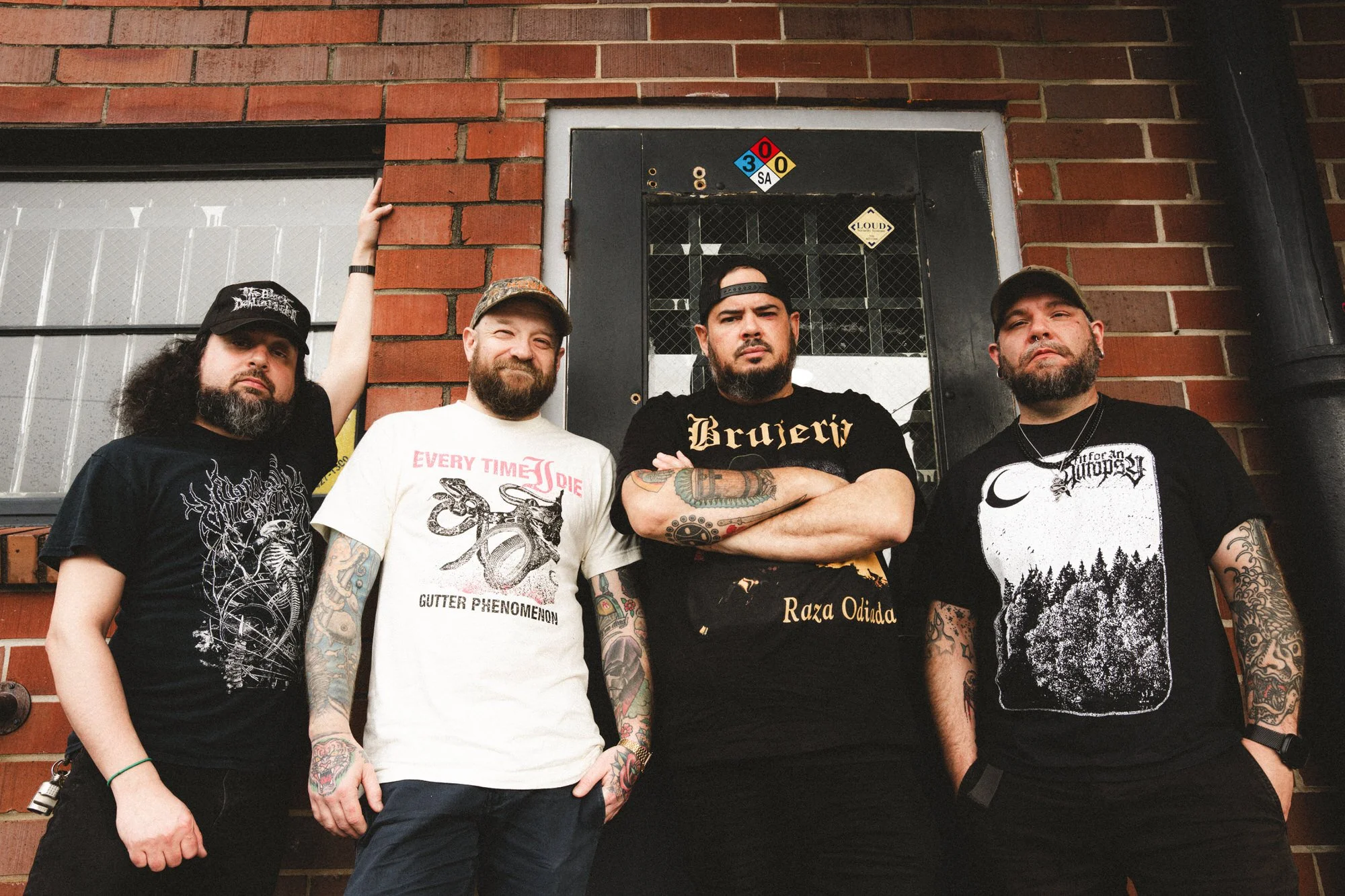
The greenroom at Boggs Social & Supply is quietly tucked away beside the stage, only feet form where the night will unfold. Inside, boxes, cables, and bits of gear left behind from previous sets are stacked into the corners. And outside the door, you can hear the nights lineup beginning to load in — the sound of cases shifting and equipment moving as the room slowly comes to life. While not the most ideal place to conduct an interview, it was just the right setting to meetLeafblower—a band more invested in their community and in building a scene together than in trying to stand apart from it.
Inside the room, the band sits close together on a worn out couch —bassist Chris Melillo, vocalist Tim Jones, guitarist Jesse Borsella, and drummer Luis Nieves — huddled up in close quarters the band talks and laughs, and move through conversation like people who have spent enough time together to complete each others thoughts with ease. Most of the conversation revolves around their favorite local bands and the charming sentiment that metal guys might be scary on the outside, but underneath it all they “will help you move” and underneath it all they’re “just a bunch of tattooed swLeafblowereeties.” One of the most enduring things I may have ever heard.
Later in the night, they will open a bill alongside fellow Atlanta favorites Palacesand Muelas—a lineup that feels less like a typical local show and more like a snapshot of bands beginning to outgrow the small rooms that built them.
But before any of that, they’re here in this crowded greenroom—talking about how the band came together, what it has become, and what it means to exist inside a city that’s constantly changing around it.
Sound Takes Shape
Like a lot of bands that formed around 2020, Leafblowerbegan as a response to isolation. Drummer Luis Nieves describes those early days simply: “We would just get in there [Ember City] and make music as a way to cope because we had no other outlet.”
At the time, the project was intentionally instrumental—something loose and exploratory. After practicing for nearly an entire year due to the shutdown, they booked their first show at the now defunct Sabbath Brewing, playing alongside Bog Monkey and Bleach Garden. It was there that friends and colleagues planted a seed— everything sounded great but something critical was missing — a vocalist.
The search for that vocalist didn’t last long.
“I went on social media the next day, within 15 minutes, and I see a post from another Atlanta musicians page and it’s from Tim,” Nieves says. “I didn’t know Tim, but I saw a comment from Brett from Turn Coldendorsing him and that’s all I needed to know.”
“Luis sent me a link to Tim’s old band Harvester. I loved his voice and immediately told Luis, this man doesn’t need to audition. I knew he had the heart, soul, and power to control this boat,” adds Borsella.
From there, the band began to take its current shape—solidifying not just in lineup, but in identity. Jones quickly took up the task of writing lyrics for the songs that the band already had, “I was incredibly inspired by what they already had, so everything just fell onto the page,” Jones says.
The addition of Jones helped the band relax into their current iteration. Staying true to formula while allowing the music to “swing and breathe” is apparent in their sound and performance — it acts as a bit of grace in an otherwise heavy discussion about grief and loss, topics that are often found in their music.
Yard Work — A Philosophy
If Leafblower has a genre, it’s their own.
They call it “yard work.”
The phrase initially reads like a joke, but the more they explain it, the more it starts to make sense within the context of who they are and what they do.
“You know, yard work is always hot, loud, and heavy,” says Jones. “Very much like the rooms we play in. The sound we have and the spirit that we have.”
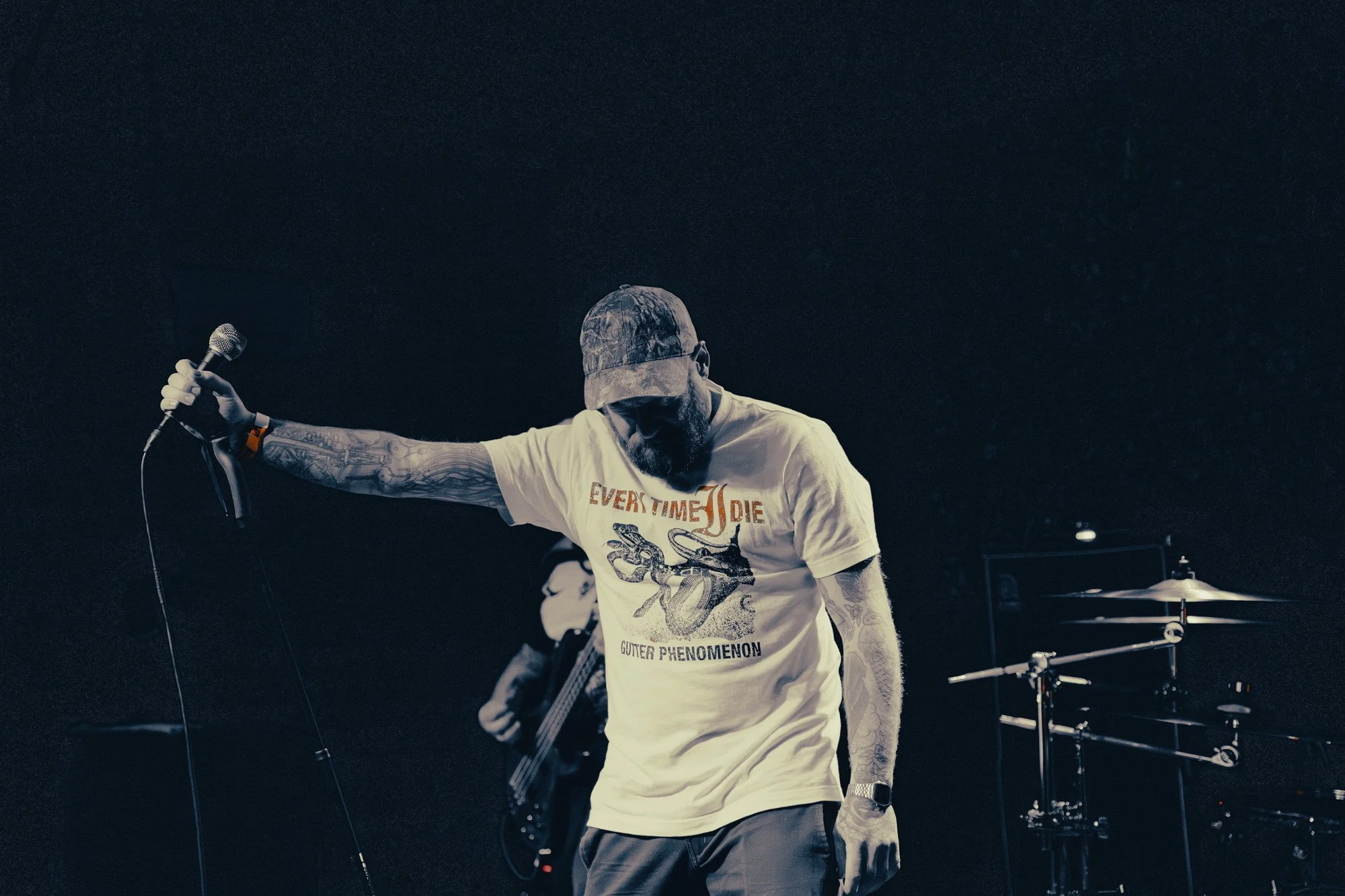
For the band, “yard work” isn’t just a sound—it’s a shared understanding between them and the audience. It’s a description rooted in the physical experience of a Leafblower show. The heat of a room. The density of the sound. The weight of the lyrical content. And the way their set moves through a space rather than just occupying it.
By the end of a set, they say, you’ll feel it.
Not metaphorically, but physically.
© Ellen Arden
The Scene and The City — Poison Creeper
The Atlanta music scene has always been expansive with a rich history in metal and hardcore. To this day, each band we sit with speaks fondly about feeling supported by the music community and the instant injection of inspiration given by sharing a stage or a room with those you admire.
“Its a very tight knit scene, and everyone is very supportive, Nieves says. “I have been part of other scenes and thats not always the case. But we have been able to make friends with nearly every band in town and play with some great bands.”
“Atlanta is unique in that way, its such a big city, but it can still have a small town vibe. You’re always seeing the same people at shows, regardless of what your interest or passion is,” adds Borsella.
“Yeah, its easy to love. It’s a community that’s also easy to fall into,” says Jones. “I’ve been playing music in Atlanta for over 20 years. Everyone is hungry here. They all have that hunger to play live, to be out here and make good records. It takes a lot of hard work and dedication, showing up and being present, putting your heart and soul into tracks. And I feel like everyone in town is doing that.”
There’s something special about the current Atlanta scene. It’s hard to define, but it shows up in the way bands aren’t competing with each other so much as building a scene alongside one another. Bills feel intentional, not accidental, and the same names keep reappearing within multiple circles—not out of sheer repetition or lack of bands, but because those people genuinely want to be in the room supporting each other.
And that incredible sense of community holds steady, even as the city around it continues to change. But with that change comes a quiet tension—felt most when the places that once held special moments begin to disappear which rattles the foundation the Atlanta scene was built on.
On their song “Poison Creeper,” the band directly addresses the transformation of Atlanta—what’s gained, what’s lost, and everything that gets left behind in the process.
Joneswrote the song while sitting in traffic on 285, looking out at a city that felt increasingly unfamiliar.
“I wrote that song as I was stuck in traffic. I was looking around at all of these new buildings and thinking about all of the old stuff that is being stripped away. A good example of those is the old Masquerade,” Jones says. “The memories that were in those walls, you can’t take them out,” he says, “I remember when they took the old sign off of that building which is now a Cash App office. It’s pretty crazy to think about how many times I have seen Gwar absolutely wreck that room. Its all cubicles now. I’m just tired of seeing money take over the city and strip away the arts.”
Though the music community is strong, it’s not lost on anyone that Atlanta has undergone one of the most dramatic gentrification shifts in the country, with thousands of residents displaced as neighborhoods are gutted and transformed. Commercial rents have surged, and small businesses—including cultural and creative spaces—are increasingly unable to survive, often operating on already thin margins. As the cost of living rises, many artists are pushed further from the city, fracturing the concert-going community that sustains the local music scene.
At the same time, the band acknowledges that change isn’t entirely negative. New venues emerge. New scenes form. But the tension between progress and preservation remains unresolved. Lest we forget, a creeper plant grows because the environment supports it—but as it spreads, it can choke out what was already there, which are often things we love.
The Work Continues
Looking ahead, Leafblower isn’t working toward a fixed outcome so much as continuing to build on what’s already taken shape. The band describes their process as something that has evolved over time—what started as simply getting in a room at Ember City and jamming has expanded into sharing ideas remotely, refining them together, and then returning to the practice space to shape the final version.
That same flexibility carries into how they’re approaching what comes next for Leafblower. New material is already in progress, with conversations around releasing an EP or collaborating on a split with other bands in the scene, though nothing is locked in quite yet. However, they do have their sites set on bigger shows and an even heavier sound.
“We’re really good at doing it our way,” Melillo laughs.
And over time, that “way” has come to mean more than just how they write or play—it’s the kind of space they create in a room, one where the line between band and crowd softens, and everyone feels like they’re part of it.
Leafblower calls what they do “yard work.”
And while the term might start as a way to describe their sound—something loud, physical, and immediate—it’s grown to represent something larger: a shared experience, a way of showing up for your neighbor, and a commitment to building something that can exist alongside a city that’s constantly changing, without losing sight of what made it matter in the first place.
By the time Leafblower takes the stage, there’s no hesitation.
They open the night, but the performance doesn’t feel like an introduction. It feels complete, tight, deliberate, and fully locked in. And it lands exactly the way they described it.
Something you don’t just hear, but you feel.
Catch Leafblower Friday, April 3rd at Sweetwater Bar and Grill with Subdivisions, Bless The Dead and Yevara.
And again on May 16th at Little Cottage Brewery’s 5th Anniversary Celebration with Black Tusk, Subdivisions, Malevich, and FNTM.
Follow FrequencyATL for local music news, interviews, and more.
CREDITS :
Interview: Ellen Arden
Editing: Tyler Brune
Additional Video: Athens GA Live
© FrequencyATL