
The Evolution of Menu — From Bedroom Synth Pop to a Louder Guitar-Driven Future
Words and Photos by Ellen Arden
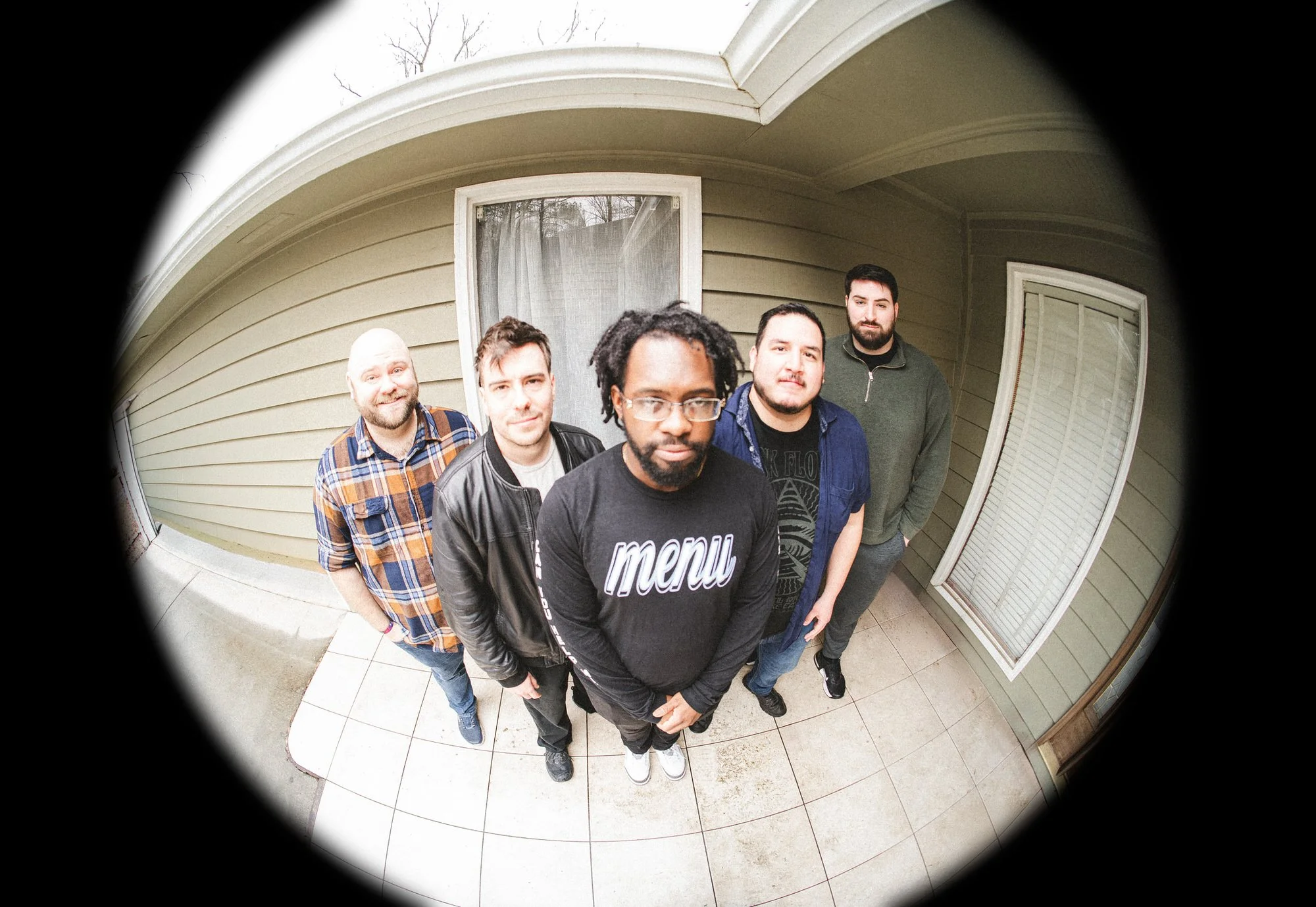
The peaceful lull of steady rain and the muted sounds of the Atlanta suburb of Snellville offered the perfect setting to meet Menu, who had gathered at a friend’s house. Inside, the atmosphere felt less like an interview and more like the start of rehearsal. The home, quietly tucked away in a cul-de-sac, was unassuming besides the five bandmates standing outside waiting for our team to arrive. Upon arrival, Menu didn’t greet me like a band preparing to be interviewed. They greeted me like I had shown up early to practice and invited me inside.
The band gathered in the living room, seated side by side on a leather sofa that has probably seen many discussions about upcoming shows, rehearsals, and work sessions. Only feet away downstairs sits an in-home recording studio where they demo and workshop the ideas each of them bring to the table.
A few weeks earlier, I was fortunate to catch Menu playing a show at Boggs Social & Supply. During their set, it was striking how tight they were as a band and how structurally well-rounded they appeared. But it was a surprise to learn they were down a member — their lead vocalist — due to illness. Many bands might collapse under those conditions. Maybe not musically, but structurally. But after just talking to them for a few minutes, you quickly realize how much of the band isn’t built around a single person holding the center, but around the collective.
Breaking Out — Beyond Bedroom Synth Pop
Menu is comprised of vocalist Miyka’el Hutchins, guitarist Steve Martin, guitarist Yoatzin Anaya, bassist James Norton, and drummer Mike Michaels.
However, they didn’t start with this lineup.
When asked how Menu started, no one gives a tidy origin story. Instead, their story is assembled collectively in fragments, with the earliest version of Menu looking less like a band and more like two friends hanging out after school. Martin and Hutchins began jamming together in 2014 simply because they were already around each other. After-school rehearsals, learning covers, small shows at local pizza parlors — a typical starting point, but without the typical ambition attached to it. They played their first set as a duo at Johnny’s Pizza, followed by Anthony’s Pizza, Mystic Grill, and eventually Shorty’s in Tucker.
“It started in 2014. Steve and I went to middle school together. We enjoyed music and video games, and we decided we’d probably benefit from chasing the music a little bit more than the video games,” says vocalist Miyka’el Hutchins.
Menu’s earliest material sounds quite different from some of their more recent releases. Their 2020 single “Dial Tone”leans into dreamy bedroom synth-pop — whimsical, sparkling with electronic textures, and carried by buoyant melodies reminiscent of Owl City, Hellogoodbye, or the dreamy indie electronica of The Postal Service. The track feels like a late arrival to the twinkling indie electro-pop wave that briefly ruled the blogosphere around 2009.
Slowly, the duo evolved into a full band by adding guitarist Yoatzin Anaya, bassist James Norton, and drummer Mike Michaels.
“We worked at Guitar Center and Music & Arts, and that’s where we met Mike and Yoatzin. They knew James, and that’s kind of how it all came together,” says guitarist Steve Martin.
Before the band settled into the sound that would eventually shape their future releases, the new iteration of Menu released the EP Homecoming in 2019 — a project that captured the band in a more experimental phase. The record pulled together many of the influences Martin and Hutchins had been exploring during the project’s earlier years, blending pop instincts with the beginnings of a fuller band dynamic that would later define their sound.
“We wanted something that kind of culminated everything that inspired us,” Hutchins explains of the EP. “It helped draw these guys in and maximize it for the stuff we’re making now.”
Now armed with a strong arsenal of melody and tone, Menu began pushing beyond their bedroom synth-pop beginnings toward a more band-driven alternative pop sound. Their 2025 releases, “Mizu” and “Castling,” trade sparkling bedroom electronics for fuller arrangements and guitar-driven hooks. Tracks like “Mizu” lean into rhythmic precision and bright guitar interplay, while “Castling”captures the band’s louder, more explosive side. Together, the singles offered a glimpse of Menu’s evolving identity — energetic, collaborative, and built around the chemistry of five musicians shaping ideas together. The band has continued building on that momentum in 2026 with two new singles, “Mariposa” and “Flowerbed,” singles that set the stage for their forthcoming debut LP, Meridian.
Building A Sound
Menu’s songs don’t feel authored so much as negotiated. The band talks about songwriting the way people talk about conversations they don’t remember starting. Riffs emerge from loose jams, and lyrics usually arrive later once the shape of a song begins to reveal itself. Musical parts stick not because anyone declares them essential, but because the band keeps returning to them, rehearsal after rehearsal, until the right version of the song slowly reveals itself.
“Usually, one person has the inspired idea,” bassist James Norton explains. “But once we’ve all gotten our hands on it, it becomes ours. And sometimes demos we bring to the table will be fully fleshed out; sometimes it’s just a riff,” he adds. “Then when we bring it in, we begin to figure out where everyone fits into it.”
That process means no single voice dominates the direction of a song. Instead, the band treats songwriting as a collaborative exercise where every member leaves a fingerprint on the final version.
“We all share a pretty heavy hand in everything — from arranging the song to deciding the tones and sounds,” Martin explains. “It takes a lot of egoless collaboration.”
Also, they don’t write with a specific genre in mind so much as they like to discover one along the way, and sometimes reluctantly. With five musicians bringing different influences into the room, the sound tends to reveal itself organically rather than by design.
“There are so many influences,” Norton says. “Pop, heavier stuff, different backgrounds — it’s kind of hard to lock it down.”
But if something survives the writing room, it probably belongs. If it doesn’t, no one fights to keep it alive. As Norton puts it, “not one voice really stands out more than any other, and by the time we’ve all gotten our hands on it, it’s ours.”
The Making of Meridian
For a band that spent years experimenting with its shape, the upcoming album Meridian represents something new for Menu — a clearer sense of identity.
Much of that clarity comes from the band’s increasingly collaborative approach to writing and recording. Ideas rarely arrive fully formed, but by the time the band enters the studio, the songs already exist in rough form, leaving the final shape open to take on new forms.
Working with producer Corey Bautista also introduced something the band hadn’t always had during their earlier self-recorded projects — an outside perspective. Instead of wearing every hat themselves, Menu leaned into letting someone else guide the engineering process, allowing them to stay focused on delivering their strongest performances.
“All I had to do was play the drums the best that I could, and Corey handled everything else. It made the whole process way less stressful,” says drummer Mike Michaels.
“Sometimes I wasn’t happy with my parts,” says guitarist Yoatzin Anaya. “Then I was free to come up with something new and better when we went into recording.”
“Since Corey was an outside perspective, he’s not as emotionally invested in the material,” Norton explains. “He was willing to say, ‘Hey, we need to get that part tighter,’ or ‘I don’t think that really serves the song.’”
That distance sharpened the recordings in ways the band might not have pushed themselves to do alone.
“What’s good enough live isn’t always good enough in the studio,” Norton adds, describing how the experience forced the band to check egos at the door, tighten their performances, and approach recording with a new level of discipline.
But recording doesn’t mark the end of the songwriting process for Menu. If anything, it extends it. Arrangements continue to evolve, and sometimes the definitive version of a song only reveals itself once the band is already in the studio.
That same collaborative thinking carries into the band’s sonic approach to performing. Menu has gradually streamlined its setup, favoring gear that allows them to recreate their recorded sound consistently both in the studio and on stage. In recent years, they’ve leaned heavily on digital modeling systems like the Helix.
“We are a Helix family at this point,” Norton laughs.
For Menu, the goal isn’t technical perfection but clarity, capturing the moment when a song finally feels complete.
Menu Finds Its Footing
Long before recording studios and album rollouts entered the picture, Menu was learning the fundamentals of being a band the simplest way possible — by playing wherever someone would let them.
Pizza parlors, restaurants, and small neighborhood venues became their first proving grounds.
“We started playing restaurants and pizza places,” Hutchins recalls. “Johnny’s Pizza was the first place that we performed.”
Those early shows weren’t glamorous, but they were essential. They gave the band a place to test songs in real time and slowly build the chemistry that now defines their sound.
As the lineup expanded and the band began playing more regularly around Atlanta, DIY venues and house shows became another important step in that progression.
Spaces like Heck House, an independent community arts venue in nearby Scottdale, offered something more valuable than a large stage or polished sound system. Originally, repurposed from an old house and designed as an accessible space for experimental art, workshops, and small performances, the venue has become part of Atlanta’s long tradition of grassroots art spaces that prioritize community over scale.
“That place was massive for us,” Martin says of the early DIY circuit. “It literally, arguably put us together.”
Even now, as the band prepares to release its first full-length album, that mindset hasn’t changed much. Menu still approaches the process the same way it always has — write together, play together, and see where the songs lead.
The Conversation Continues…
With two new singles already surfacing from the upcoming record — including the recently released “Flowerbed” — Menu is now turning its focus toward the arrival of Meridian. Earlier singles like “Mizu” and “Castling” offered the first real glimpse of where the band has been heading: brighter guitars, sharper rhythms, and a sound that leans more confidently into the energy of a full band.
“Our heart and soul is really in the loud stuff,” Martin says of the band’s newer material, pointing to “Castling” as a track that captures that momentum.
While Meridian represents the clearest version of Menu so far, the band seems less interested in defining their sound than in continuing to discover it. New songs are already being drafted, ideas passed between members, and future directions tested in rehearsal rooms and live shows. For a band that has spent more than a decade slowly assembling itself piece by piece, the next chapter doesn’t feel like a reinvention but the natural continuation of a conversation that started long before the album ever existed.
Menu will celebrate the release of Meridian with a show on April 3 at Boggs Social & Supply.
Stream “Mariposa” and “Flowerbed” on Spotify and Apple Music today.
Follow @frequency.atl for local music news, interviews, and more.
Credits :
Interview: Ellen Arden
Editing: Tyler Brune
© FrequencyATL