
Spiritless : Between Songs and Silence
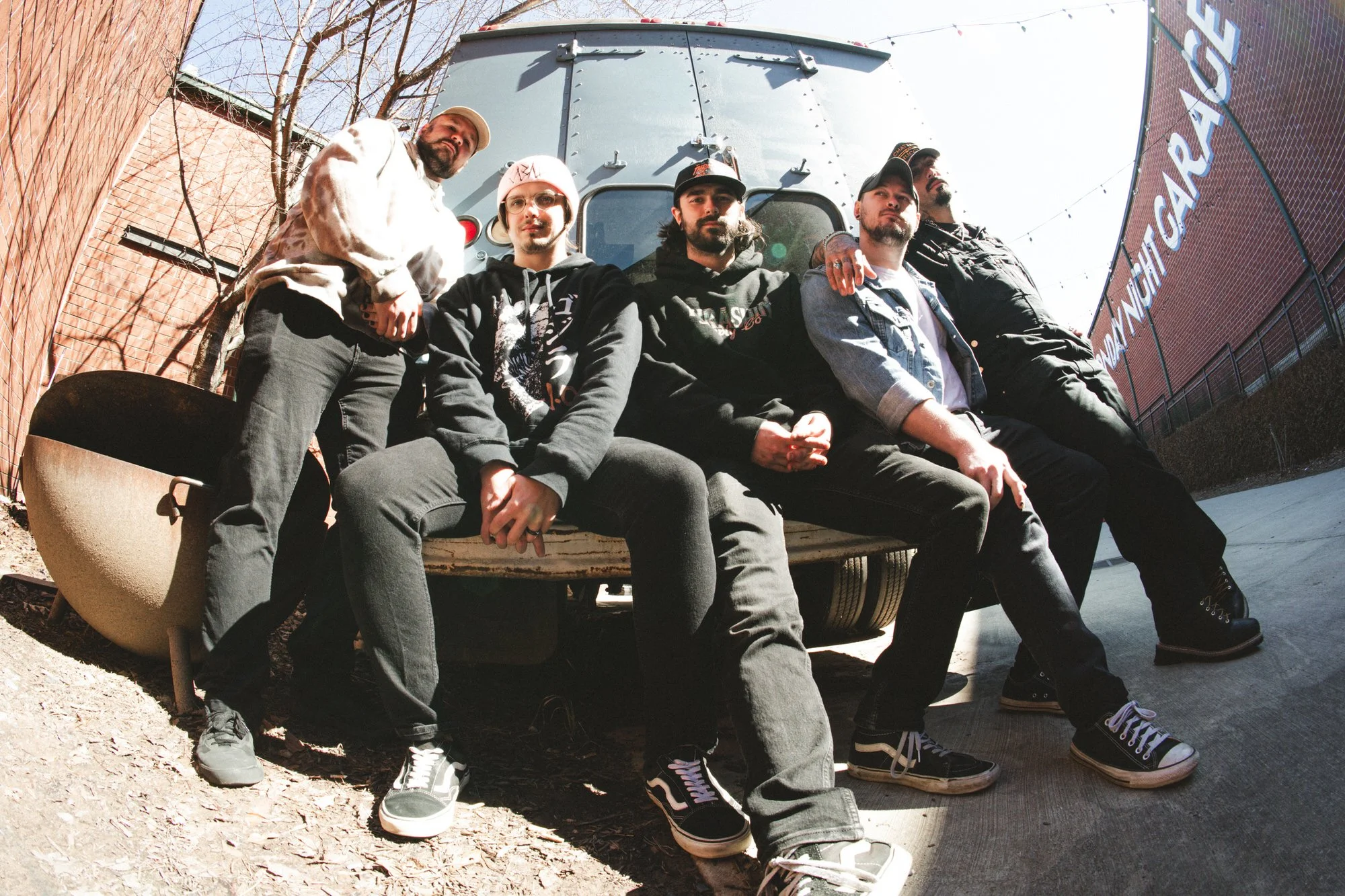
Words & Photos by Ellen Arden
Despite bitter, hostile winds cutting through the city, our team muscled up the courage to pack up our gear and leave our homes for an interview with a band making considerable waves in the Atlanta music scene — Spiritless.
After hearing from countless friends and colleagues in the scene that Spiritless was a band we needed to cover, the decision finally made itself when we caught their set during Atlanta’s Emo Nite at The Masquerade. Emo Nite — a celebration of shared nostalgia, a love of music, and community — turned out to be the perfect environment to see the band in its element and playing to a packed room of genuinely invested fans. Between breakdowns, down-tuned guitars, and cavernous vocals, Spiritless didn’t just perform; they locked into the crowd, delivering the kind of confidence some bands spend years chasing before they ever feel ready to step onstage.
Only days later, the heavy and chaotic energy of that night felt almost suspiciously absent.
We met Spiritless in the West End on a frigid afternoon that didn’t exactly invite anyone to linger outside, but as they took their seats at our table, their intensity from the stage evolved into something more warm and inviting: just five good friends talking about gear, shows, and whose idea it was to schedule anything outside in February.
For the record, that was our choice.
On Becoming Spiritless
Spiritless is comprised of vocalist Hunter Taylor, guitarist Josh Nevil, bassist Ian Wobb, guitarist Johnny McLain, and drummer Danny Martin.
The metalcore band didn’t begin with a manifesto or a planned lineup. It formed the way most bands are born—different projects, shared bills, Reddit posts, overlapping friend groups, and/or seeing each other at shows.
Spiritless came together in a similar fashion. Vocalist Hunter Taylor and bassist Ian Wobb were in a previous band together that did not end on the best of terms, but soon after Taylor and Wobb got together for a Knocked Loose show at Masquerade. That meeting inspired them to start a new project. Unsure of where it would go, Taylor and Wobb spent the next two and a half years writing with ghostwriters to make music, until reaching out to guitarist Johnny McLain.
“I barely knew Johnny,” vocalist Taylor admits. “I just knew he sounded insane onstage. Then we found Josh on TikTok shop,” he laughs.
“We were all in different bands,” says guitarist Josh Nevil. “Then COVID hit and everything kind of fell apart. So, I started doing videos of guitar reworks and covers. Then Hunter reached out to me on TikTok, wondering if I would be down to play. And the next thing you know, we were all chitchatting and meeting up. The rest is history; we started rocking from there.”
Drummer Danny Martin was pure chance.
“We just so happen to have a mutual friend and she reached out to me to see if I wanted to go check out this band that she knew. When we got there the guys were like, “So yeah… we don't have a drummer tonight. We're running tracks and we were going to play a cover.” And I just so happened to know how to play that cover. So, I talked to Hunter, and he was like, “Yeah, let’s try it man.” I had literally known this guy for all of 10 minutes before I played a show with them,” says Martin.
Most bands form around a vocalist/songwriter with an idea. Spiritless formed around absence — no single voice directing the thing they were becoming, which meant they had to learn how to function with the future in mind.
“There were six months where it was just me, Johnny, and Ian and we didn’t even talk to each other. We didn’t think this was ever going to go anywhere. Then we dropped “Lost Souls” just because it was done and did a video, and suddenly the numbers started climbing on our debut single. That put a fire under our ass to keep going. Maybe we actually had something here,” says Taylor.
All of the newer songs are written by the five-piece, but several carry-overs still exist and have been reworked to represent the band collectively. Spiritless invokes a collaborative approach that changes how their music evolves; their songs are not constructed as much as they are negotiated — an idea survives only by convincing everyone else it deserves a chance.
They don’t vote, exactly, but they also don’t defer.
“There are five of us — so, if a decision needs to be made and there’s a majority, it’s happening,” Nevil says. “But you have to have a reason. You can’t just say no, I don’t want to,” Taylor adds.
This explains why Spiritless’ current recordings don’t always feel like their early demos—or sometimes even their current live versions. Their music is free to change because nobody treats it as a precious object.
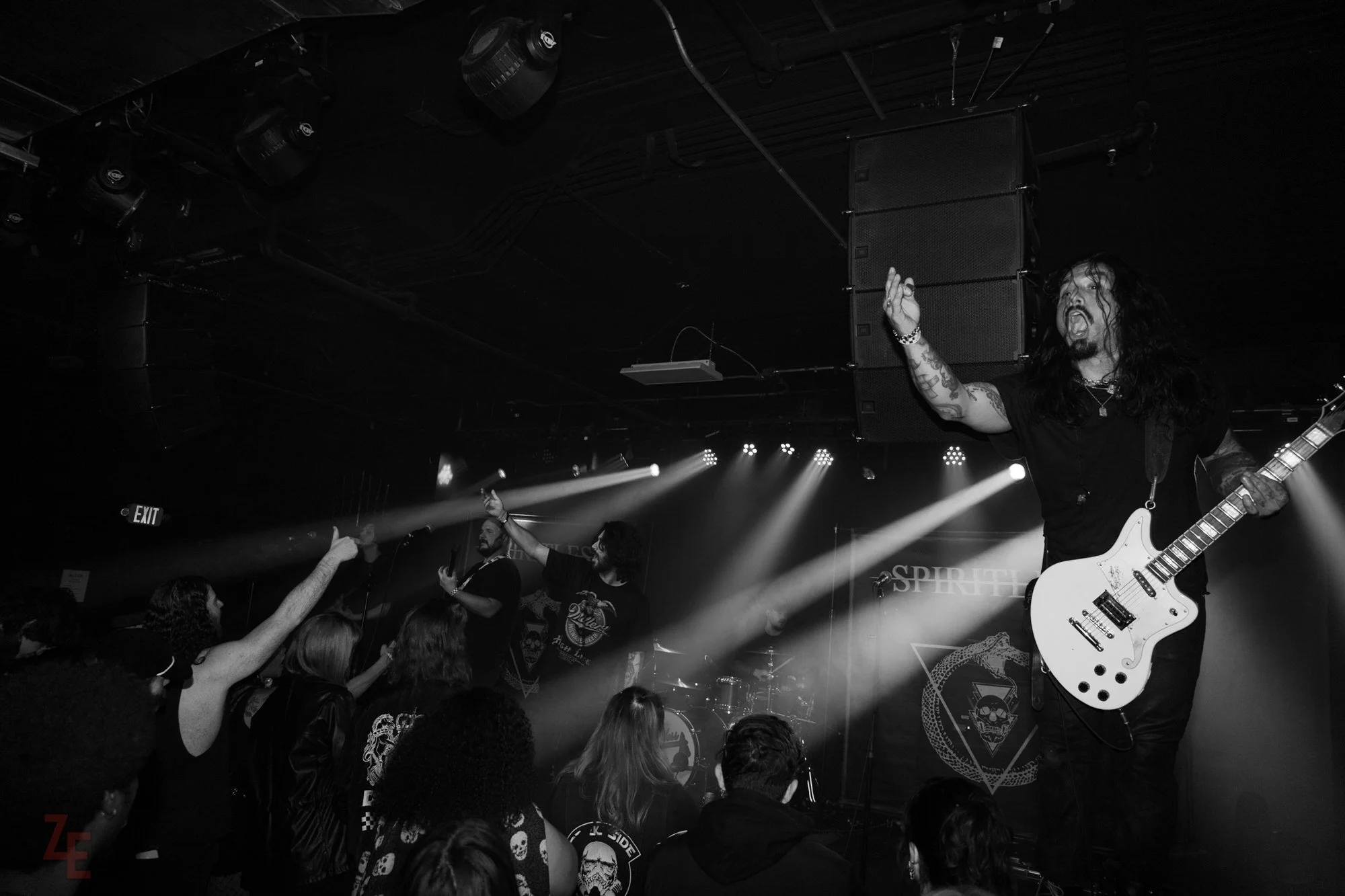
© Zac Edwards
Heavy Sound & The Gear That Makes It
For a band that sounds mechanically tight live, Spiritless actually runs a surprisingly low-maintenance operation. Their tone isn’t built around rare gear or obsessive pedal collecting — it’s built around familiarity, reliability, and control.
Recently transitioning from Istanbul Agop cymbals to mainly Zildjian and SJC drums, Martin learned early on that impact matters more than brand loyalty.
“Your snare cuts through everything,” he says, while describing what he looks for live — it’s less about prestige equipment and more about what sonically cuts through the room.
That philosophy runs across the entire band: make the sound hit first, worry about the mythology later.
McLain intentionally keeps his setup minimal onstage—
“I try to keep my pedal board pretty simple live and focus more on my performance rather than tap dancing,” he explains.
Instead of stacking effects, Spiritless separates environments. Stating that their live performance is about consistency. The recording studio is where they experiment.
Their recordings rely heavily on pitch manipulation and textural layering — particularly a DigiTech Whammy pedal, which McLain says he uses less for riffs and more for atmosphere:
“Not for main guitar parts — just weird sounds and layers to add dynamics.”
Their core heaviness, though, comes from something far less mysterious: modern high-gain modeling.
The band uses EVH 5150-style amp modeling — a tone known for a tight low end and aggressive midrange bite — paired with digital processors like the Axe-Fx and Line 6 Helix. And bassist Wobb values that practicality as much as he does tone. “All I gotta do is hit a button. I’m in tune,” he says.
And that matters because Spiritless doesn’t stay in one tuning for long.
“We bounce tuning six times in our current set,” says Nevil.
Instead of swapping guitars mid-set, they digitally shift pitch — letting songs drop from Drop B into lower tunings without losing clarity. The result is the band’s defining sound: controlled chaos — tight enough to punch, low enough to feel unstable.
Even their guitars reflect that balance between individuality and function. Nevil gravitates toward unusual shapes, specifically D’Angelico models more commonly associated with jazz and blues players than metal bands.
“It’s not quite the standard Fender-style Jag look… but it just rips as a guitar,” he says, noting that players in heavier music rarely use them.
In the end, the setup matters only in how little it does — every piece chosen so their stage sound doesn’t feel produced but feels real and heavy in the moment. The goal isn’t perfection so much as immediacy, removing anything that slows the connection between the band and the room. It’s a philosophy that makes more sense once you see where they came from, as in Atlanta the show has always mattered more than the gear and spectacle around it.
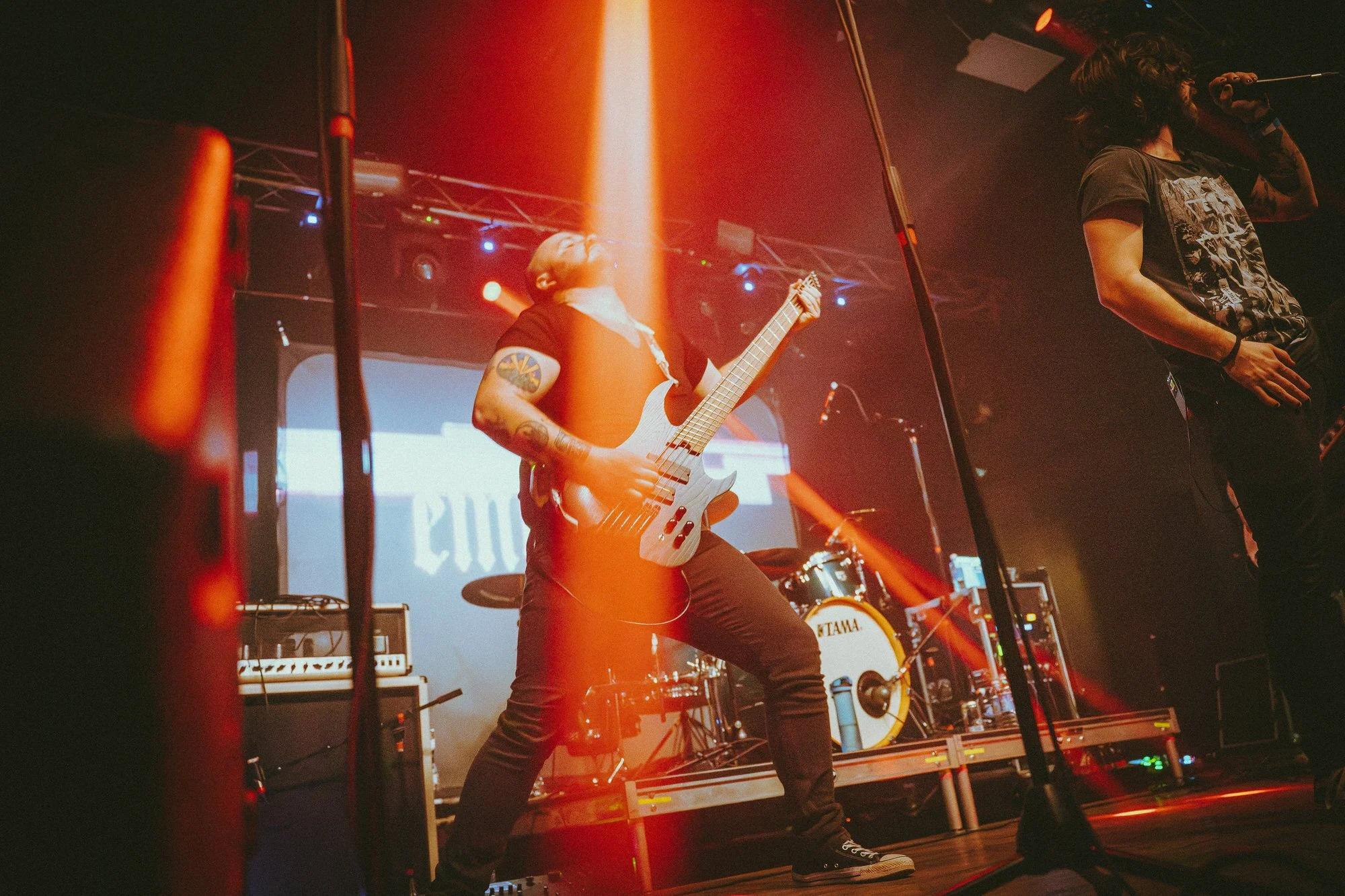
© Ellen Arden
Winning At Home
Atlanta is a place that keeps bands alive long enough to become themselves to find their footing and their audience before hitting the road. And with numerous shows at local venues like 529, Masquerade, and Sweetwater Bar and Grill, Spiritless doesn’t talk about Atlanta like a stepping stone, they talk about it like infrastructure.
“Right now, I feel like we need to win at home before we can go out on the road,” says Wobb.
“You need to set up a home base and hang out and get to know everyone where you’re at first,” adds Nevil.
Winning at home is definitely happening for Spiritless, as they have won the admiration of many local fans, bands, and venues. They don’t do their shows as a form of exposure as much as they just strive to give a great performance and engage with the crowd who could otherwise listen to their music from home. And this approach has helped them carve out a dedicated following in the Atlanta scene, allowing them to sell out shows.
“You start seeing the same people every week,” Martin says. “Then suddenly you’re part of it.”
The band describes the Atlanta scene less as competitive and more as cyclical with musicians shifting projects, sharing members, reappearing in new forms, and being on mixed bills with new musicians to start the loop all over again. Mixed bills, in fact, is one of their favorite tickets to be part of.
“We actually prefer mixed genre bills,” says Taylor.
“We did our first annual show last year on Halloween at Sweetwater, and it had everything. It had everything from folk to hardcore to pop punk and metal. It was great. So many different musicians under one umbrella and something for everyone,” adds Nevil.
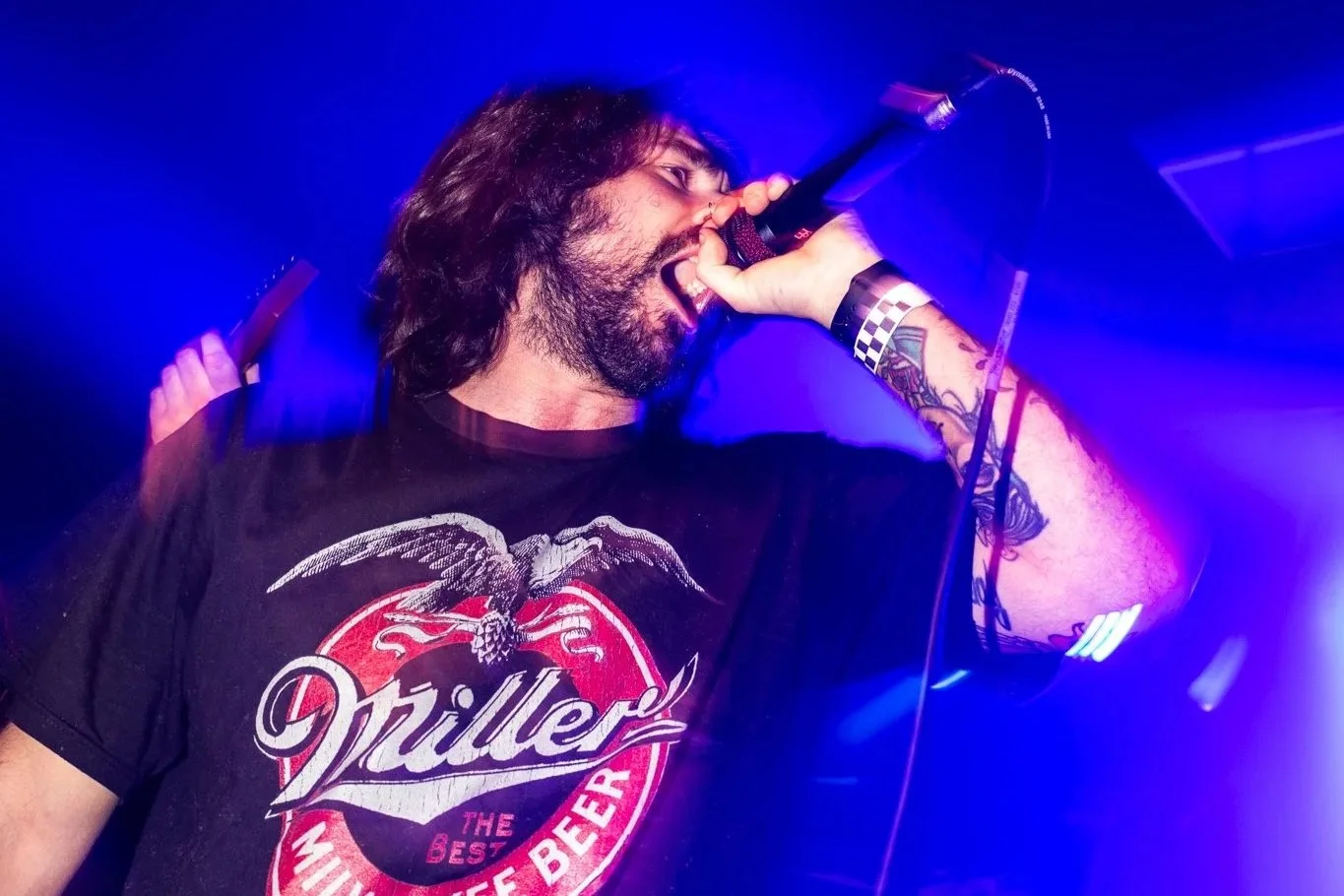
© Zac Edwards
Where It Goes From Here
But right now, the present tense matters more than the backstory. Spiritless are in the middle of a transition with heavier songs, a clearer identity, and the first material that feels fully theirs.
With their most recent track, Dead Roses, released in February and garnering some attention, there are certainly more releases coming behind it.
“This is probably one of the more sad songs we’ve written,” Taylor says about the new material.
“It’s radio-friendly but it has very heavy elements to it. So, it’s still feels like us at the end of the day,” adds McLain.
The emotional weight of the track doesn’t replace aggression as much as it sharpens it to a dangerous point. Focusing on the theme of loss an emotionally heavy EP is sure to follow in the coming months.
After spending hours freezing in the sun with them, the easiest mistake here would be to frame Spiritless as a band trying to become the next big metalcore band on the scene. But there is no grand aesthetic, no mythology, and no desire to be the heaviest band in the room. They just keep refining what happens naturally when the same five people keep writing songs together long enough to trust each other on their collective direction.
Upcoming shows are already scheduled, with the next show happening March 7th at 529 with Weeping Wound, In Gloom, Don’t Shoot The Messenger, and Dead Friends.
A headline record release show and a Southeast tour with Heroes for Ghosts is in the wings.
And a new EP is on the horizon.
Until then find Spiritless online at Instagram · TikTok · Spotify and Apple Music.
Follow @frequency.atl for local music news, interviews, and more.
Credits :
Interview: Trudie Storck
Editing: Tyler Brune
Additional Photography: Zac Edwards
© FrequencyATL